War Weariness in Numbers: Casualties, Exit Plans and the Limits of Public Patience
In March 2026, 63% called U.S. casualties unacceptable and 66% preferred ending involvement quickly. What the war-weariness numbers do and don't show.
Wars have a political half-life. Public support is highest at the start and tends to decay, and the question is how fast and how far. The 2026 Iran conflict has produced a clean set of early measurements.
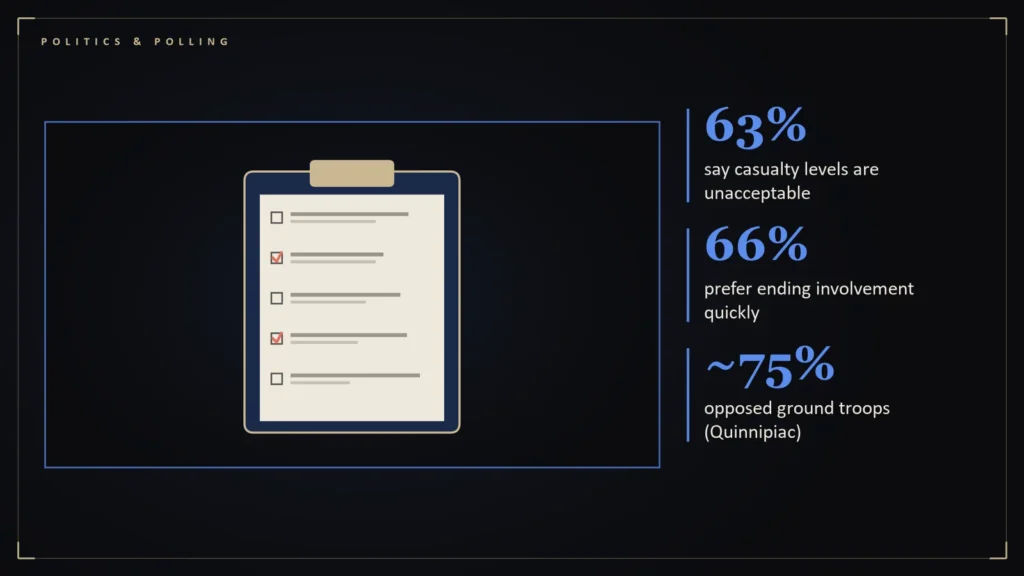
- In mid-March 2026 polling, 63 percent of Americans said casualty levels in Iran were unacceptable [1].
- Sixty-six percent preferred ending involvement quickly even if that meant not achieving all U.S. goals [1].
- Quinnipiac found about 75 percent opposed ground troops after six service member deaths were announced [2].
- Gallup’s June 2026 poll found 34 percent approved of the military action [3].
The casualty threshold
In reporting on mid-March 2026 polling, 63 percent of Americans said casualty levels were unacceptable [1]. Quinnipiac asked about ground deployments after six service member deaths were announced, and about 75 percent of voters opposed sending ground troops, versus about 20 percent in favor [2]. The numbers come from soon after the first losses, which is when opinion is often at its most reactive.
The exit preference
Sixty-six percent said they would rather end U.S. involvement quickly “even if it means we do not achieve all of our goals in Iran” [1]. That is a revealing wording, because it forces a trade-off, and a large majority picked the exit.
Three months later
By June 1-15, Gallup found 34 percent approving of the military action, compared with levels for the Gulf War and Afghanistan that were higher [3]. The sequence is consistent with the familiar pattern of eroding support, but it does not prove one: the polls used different questions, samples and dates.
Support over time, and the older pattern
Public support for a military operation tends to erode as it goes on, and the available polls fit that pattern. Early in the war, about 4 in 10 Americans supported the strikes and roughly half opposed them [1]; a March Indeed poll put approval at 40 percent among registered voters, and Gallup’s June 1 to 15 poll found 34 percent approving [3]. These are different polls with different wording, so they do not form one clean series, but the direction is the same as the one in the casualty and exit questions.
Gallup’s own history shows how common the slide is. Approval of the 2011 Libya operation fell from 47 percent to 39 percent in follow-up polling, and for the 1994 Haiti intervention from 54 percent to 36 percent, while the Iran action’s 34 percent is below the levels recorded for the Gulf War and the war in Afghanistan [3]. Support was strongest among older Americans and men [3]. Taken together, the polls suggest patience is shorter when casualties are announced early and goals are unclear, a pattern that Gallup’s earlier comparisons make visible [1][3].
What patience depends on
Researchers who study wartime opinion tend to point to three drivers: perceived success, perceived cost, and elite cues. This evidence speaks mainly to cost, in the form of casualties, and to expectations about the end. It says little about perceived success, which polls rarely measure well.
The responsible reading is modest. Americans, in these polls, tolerate a limited operation more than they endorse escalation, they are sensitive to casualties, and they prefer an exit to an open-ended commitment. How that translates into votes is a separate question that November will answer.
Questions readers ask
How many Americans found casualties unacceptable?
In mid-March 2026 polling, 63 percent said casualty levels in Iran were unacceptable [1].
Did Americans prefer a quick exit?
Sixty-six percent preferred ending involvement quickly even if not all goals were achieved [1].
References
- Americans have little appetite for sending U.S. troops to Iran, polls show — Anchorage Daily News — https://www.adn.com/nation-world/2026/04/01/americans-have-little-appetite-for-sending-us-troops-to-iran-polls-show/
- Polls show what Americans think about the war in Iran — PBS NewsHour — https://www.pbs.org/newshour/politics/polls-show-what-americans-think-about-the-war-in-iran.
- Poll reveals how public support for Iran war compares to other U.S. conflicts — Fox 5 NY, reporting Gallup — https://www.fox5ny.com/news/poll-reveals-how-public-support-iran-war-compares-other-us-conflicts