The Fear Index: How Safe Americans Feel Voting in 2026
A March 2026 survey found 48% feel completely safe at polling places and 59% fear voter harassment. What it measures, and what its online sample cannot prove.
Election confidence is usually about the count. A different kind of confidence is about the room: whether a voter feels safe walking into it. A 2026 survey tried to measure that second kind.
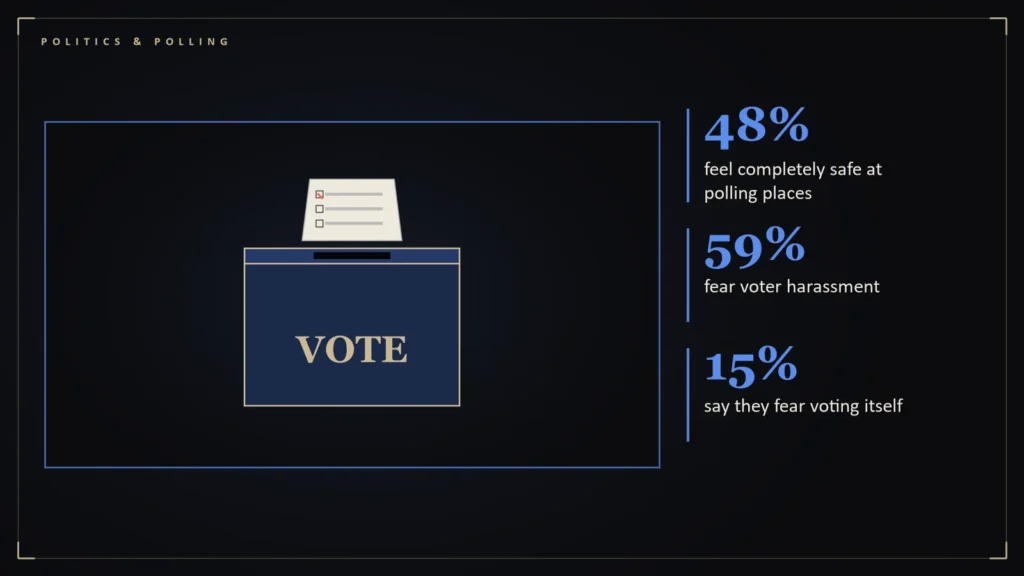
- The GPAHE poll by Edge Research (March 9-19, 2026, 1,552 adults) found 48 percent feel completely safe at polling places, and 68 percent feel nervous or afraid engaging in routine political activity [1].
- More than 60 percent worry about weapons and violent attacks at polling places, and 59 percent fear voter harassment [1].
- Fifteen percent say they fear voting itself, including 22 percent of Gen Z, 19 percent of Latinos and 15 percent of Black Americans [1].
- The survey was online with a non-probability sample and demographic quotas, so treat its figures as indicative, not precise [1].
What the poll asked, and of whom
The Global Project Against Hate and Extremism commissioned Edge Research to survey 1,552 U.S. adults from March 9 to 19, 2026. The sample was online and non-probability, built with demographic quotas, which limits how precisely the results can be generalized [1]. That caveat belongs next to every figure below.
The numbers
- 68 percent said they feel nervous or afraid engaging in routine political activities [1].
- Only 48 percent said they feel completely safe at polling places [1].
- 15 percent said they feel afraid of voting itself, including 22 percent of Gen Z respondents, 19 percent of Latino respondents and 15 percent of Black respondents [1].
- More than 60 percent worry about weapons and violent attacks at polling places, 59 percent about voter harassment, and 53 percent about the deployment of ICE or the National Guard [1].
Some would leave
The survey also asked what voters would do if harassed: 21 percent of Black voters and 22 percent of Latino voters said they would leave without voting [1]. If those intentions hold, the consequence is not only a lower turnout, but an uneven one.
Fear and its consequences
The survey connects fear to action. About 15 percent said they would leave without voting if they witnessed or experienced harassment or intimidation, including 21 percent of Black respondents, 22 percent of Latino respondents, 19 percent of Gen Z and 11 percent of white respondents [1]. Only 30 percent said they would speak up in the moment [1]. Separately, 53 percent were afraid of ICE or the National Guard being deployed to monitor polling stations, and 68 percent said a ban on firearms at polling places would make them feel safer, including 62 percent of gun owners [1].
The broader findings frame the mood: 84 percent said political violence is a problem in America, 65 percent said it is never justified (51 percent of Gen Z against 79 percent of Boomers), and 44 percent were not confident that elections will be free and fair [1]. The same report found that 59 percent say they are afraid of voter fraud at elections, a separate item from the 59 percent who fear people being harassed at the polls, so two different worries happen to share a number [1]. Because the poll is a non-probability online sample, these are indications of mood, not exact population values.
Violence and the wider mood
On political violence, 84 percent said it is a problem, with 57 percent of Democrats and 40 percent of Republicans calling it a very big one; 65 percent said violence is never justified, while about a third disagreed [1]. Only 26 percent were very confident that elections are free and fair [1].
How seriously to take these numbers depends on the method, and the method is the weaker kind. But they are a record of worry, and worry is a fact even when the thing worried about is rare. Election officials who want high turnout have a measurable job: make people feel as safe as they in fact are.
Questions readers ask
How safe do Americans feel at polling places?
In a March 2026 online survey, 48 percent said they feel completely safe at polling places, while more than 60 percent worried about weapons and violent attacks [1].
How reliable is the GPAHE survey?
It used an online non-probability sample with quotas, so its figures are indicative rather than precise [1].
References
- Americans Have Significant Fears About Voting: Survey 2026 — Global Project Against Hate and Extremism — https://globalextremism.org/post/americans-have-significant-fears-about-voting-survey-2026/