The Quarter of the Market Nobody Is Counting: Bootlegs and Fan-Made Merch
MIDiA estimates about a quarter of merch buying goes to unofficial sellers. Bootlegs and fan-made designs are both a leak and a love letter.
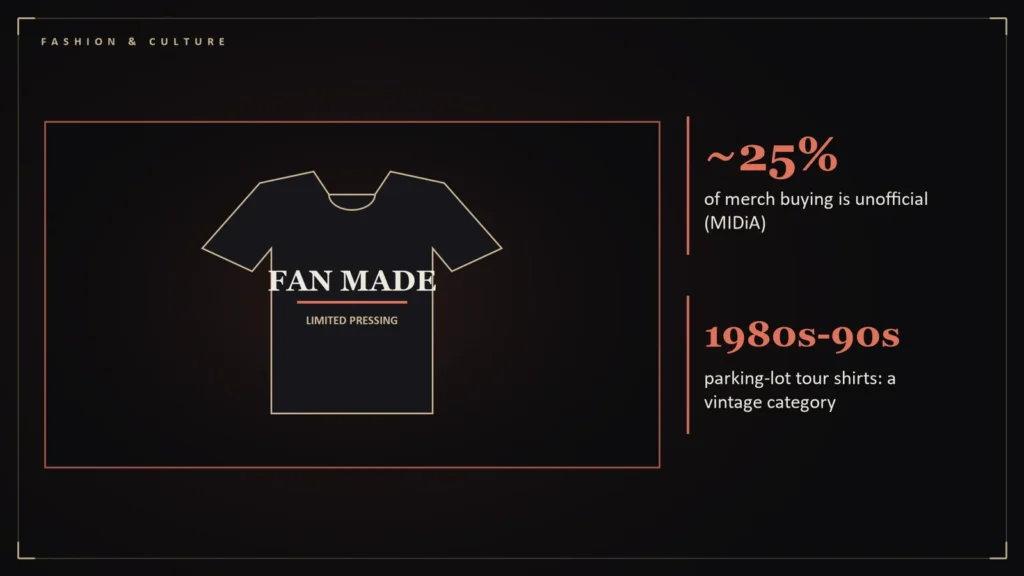
Every music scene has a shadow economy, and it is made of people who love the band a little too much to wait for official merch. A fan in a garage with a screen-printing frame is not the enemy of the music business. She is its most honest market research.
- MIDiA Research estimates about one-quarter of merchandise purchasing comes from unofficial vendors, including fan-made and second-hand sellers [1].
- Era-correct unlicensed merch, such as 1980s and 1990s parking-lot tour shirts, is a recognized vintage category [2].
- In rap and hip-hop, fan-made pieces are sometimes better than official merch and are often counterfeited, which makes hands-on comparison necessary [3].
A quarter of the market
MIDiA Research estimates that around a quarter of merchandise purchasing goes to unofficial vendors, a bucket that covers fan-made products and second-hand markets [1]. For official sellers, that is a leak. For everyone else, it is evidence of demand that supply has failed to meet: fans want designs the official table never made, in sizes it never stocked, at prices it never offered.
Some bootlegs become heirlooms
Time rewrites the category. Dealers treat era-correct unlicensed merch, the 1980s and 1990s parking-lot shirts sold outside venues, as a recognized vintage genre, authenticated by its tag, stitching and print like any licensed piece [2]. The vendor who undercut the band in 1989 is now a footnote that collectors pay for.
The scene’s own experts say fan work can beat the official line. Gene Melkisethian of the Washington, D.C. shop Joint Custody notes that in rap and hip-hop, fan-made pieces are sometimes superior to official merchandise and frequently counterfeited, so judging them takes hands-on comparison [3].
What the market study counts as merch
MIDiA’s report covers three segments: digital merchandise such as in-game items, physical merchandise such as apparel and accessories, and physical music such as vinyl, CDs and cassettes, with physical music revenue expected to peak in 2026 and then decline [1]. About a quarter of merchandise purchasing happens outside official channels, through fan-made merchandise, Etsy pages and secondhand markets [1]. The report points to a shift toward merchandise with utility or interactivity, citing Japanese Breakfast’s chopsticks and Lady Gaga’s rain boots [1].
It also supplies a pricing example: at Billie Eilish’s SoHo pop-up, shoelaces were $20, belts and neckties $30 each and necklaces $60 [1]. And it carries a warning that applies to bootlegs: the whole merch business rests on fandom, and over-monetization could damage the relationship with fans [1]. That is the other side of the unofficial market, because a fan who makes or buys unofficial goods is often expressing the same attachment the official shop is trying to monetize.
Where the line is
Not every unofficial product is a love letter. Selling a band’s name and logo without permission takes money from the people who made the music, and counterfeiting is a different thing from homage. A fan can still do the right thing at small scale: buy from artists who sell their own designs, from makers who collaborate with bands, and from secondhand sellers who are honest about what a piece is.
For a band or shop, the practical reading of that quarter is simple. If a quarter of buyers go elsewhere, ask what the elsewhere has that you do not, and then make it yourself, officially, before somebody else prints it.
Questions readers ask
How much merch is bought from unofficial sellers?
MIDiA Research estimates about a quarter of merchandise purchasing goes to unofficial vendors, including fan-made and second-hand sources [1].
Is a bootleg band shirt valuable?
It can be: era-correct parking-lot bootlegs from the 1980s and 1990s are a recognized vintage category, judged by tag, stitching and print [2].
References
- How Big Can Music Merch Get? MIDiA's Latest Report Charts the Course to $16B by 2030 — MIDiA Research — https://www.midiaresearch.com/blog/how-big-can-music-merch-get-midias-latest-report-charts-the-course-to-16b-by-2030
- Vintage Tee Authentication Guide — Keep It Classic — https://keepitclassiclv.com/pages/vintage-tee-authentication-guide
- Vintage Band Tee or Fake? Joint Custody Shares 9 Tips to Spot the Real Thing — DC Fray — https://districtfray.com/articles/vintage-band-tees-joint-custody