The Theremin: Music Played Without Touching Anything
Lev Theremin's instrument turns hand motion in the air into pitch and volume. Invented around 1919, patented in 1928, it inspired Robert Moog at age 14.
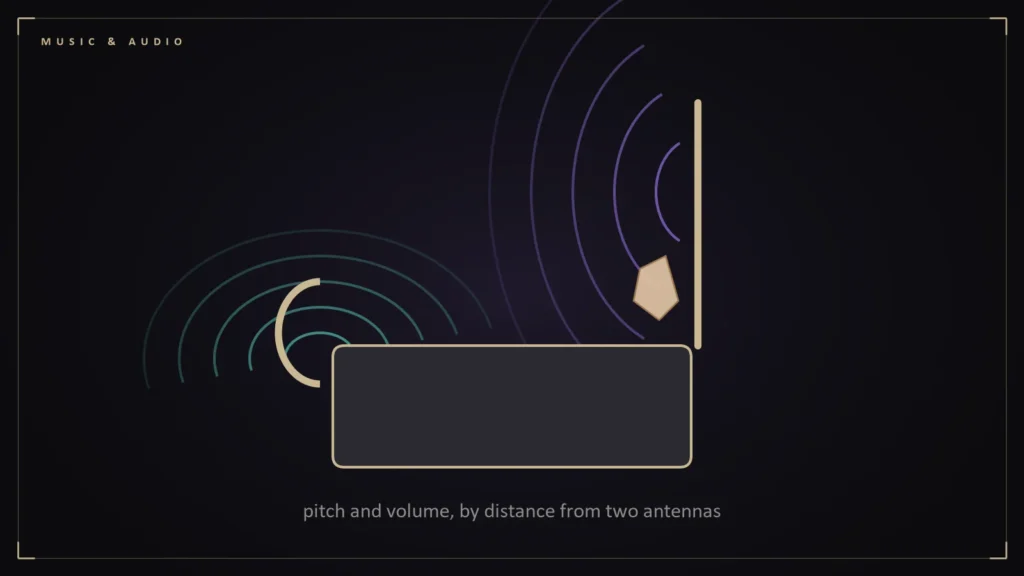
The theremin is the only mainstream instrument you play by not touching it. The performer stands in front of a box and shapes sound out of thin air, like a conductor whose gestures make the sound directly.
- Lev Theremin invented the instrument in 1919, and it made its first public appearance in 1920 [1].
- It has no strings or moving parts and turns hand motion in the air into pitch and volume using heterodyning [1].
- Theremin discovered the effect by accident in 1918 while working on a radio transmitter-receiver for the Soviet military [1].
- He received U.S. Patent 1,661,058 in February 1928 [1].
An accident in a radio lab
Smithsonian Magazine tells the story. Lev Theremin, a Russian musician and scientist, was working in 1918 on a radio transmitter-receiver for the Soviet military when he noticed the sound changed as he moved his hand near it [1]. He invented the instrument in 1919, and it first appeared in public in 1920 [1].
How it plays
The instrument has no strings or moving parts. It translates hand gestures and motion in the air into pitch and volume, using the principle of heterodyning [1]. Heterodyning combines two high frequencies so that their difference falls in the range of hearing. A player’s hands change the electrical field near two antennas, and that shifts the tone and loudness.
Patented in America
Theremin received his U.S. patent, number 1,661,058, in February 1928. The application described a method of producing musical tones of variable pitch, volume and timbre in imitation of the human voice and known instruments [1].
Echoes in popular music
The Smithsonian article notes that Jimmy Page played a theremin in Led Zeppelin’s “Dazed and Confused” and “Whole Lotta Love,” and that the instrument appeared in the film First Man [1]. Robert Moog built his own theremin at 14 from magazine drawings [1]. That teenage project grew into the company behind the synthesiser; read how the Moog synthesizer arrived.
From Lenin to the work camp
A second Smithsonian account adds the biography. A physicist and trained cellist, Theremin was developing proximity sensors that used sound waves when he realized he could manipulate waves between two antennas to make something like a warbling violin [2]. Lenin was so impressed by a 1922 demonstration that he sent Theremin on a tour of Russia, Europe and the United States, partly to show off a modern Soviet sound and, according to the article, to engage in industrial espionage; from December 1927 he toured the United States widely, with stops including the New York Philharmonic and Carnegie Hall [2].
The ending was harsh. When Theremin returned to the Soviet Union in 1938 he was sent to a work camp and made to build bugging and listening devices [2]. The instrument, meanwhile, found a following and sold for about $175 each, roughly $2,600 today [2]. The player Carolina Eyck says no other instrument is played without physical contact, so “you are part of the instrument, conducting the air,” and the article notes that one theremin belonged to Robert Moog, who created the first commercial synthesizer in 1964 [2].
Why it still fascinates
- No contact. The player has no frets or keys to guide the hands, so pitch depends on ear and muscle memory.
- A direct line to electronics. It is an early electronic instrument and an ancestor of the synthesiser.
- A contested attribution. Some sources dispute the theremin on certain famous records, so check before repeating a claim.
Questions readers ask
How does a theremin work?
It turns hand motion near two antennas into pitch and volume using heterodyning, with no strings or moving parts [1].
When was the theremin invented?
Lev Theremin invented it in 1919, and it first appeared in public in 1920 [1].
References
- A Century Ago, This Eerie-Sounding Instrument Ushered in Electronic Music, Smithsonian Magazine — https://www.smithsonianmag.com/innovation/century-ago-this-eerie-sounding-instrument-ushered-in-electronic-music-180973126/
- The Soviet Spy Who Invented the First Major Electronic Instrument, Smithsonian Magazine — https://www.smithsonianmag.com/smart-news/theremin-100-years-anniversary-instrument-music-history-180976437/