The Voyager Golden Record: What Earth Put in a Bottle
Voyager 2 launched August 20, 1977 with a gold-plated record holding 115 images, natural sounds, 55 greetings and 90 minutes of music chosen by Carl Sagan.
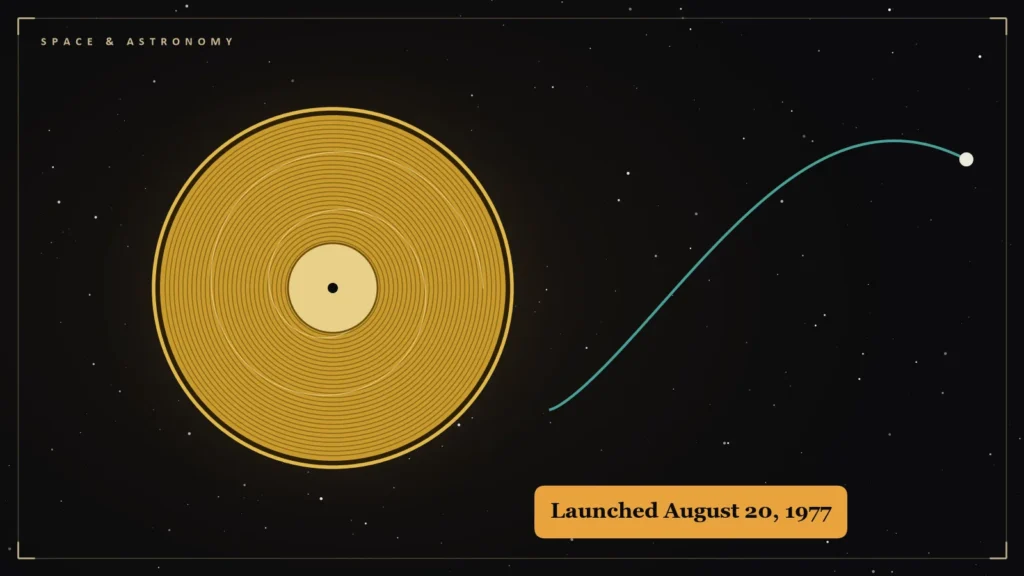
Imagine writing a letter you will never see answered, and sealing it in a bottle that will outlast your planet. That is the Golden Record. Launched on both Voyager spacecraft in 1977, it is a gift to no one in particular.
- Voyager 2 launched on August 20, 1977 [1].
- Each Voyager carries a 12-inch gold-plated phonograph record designed to play at 16-2/3 revolutions per minute [2].
- It holds 115 images in analog form, natural sounds, greetings in 55 languages from Akkadian to Wu, and a 90-minute selection of music [2].
- A committee chaired by Carl Sagan of Cornell University chose the contents [2].
The launch
NASA’s Jet Propulsion Laboratory lists Voyager 2’s launch date as August 20, 1977 [1]. It later became the only spacecraft to visit Uranus and Neptune [1].
What is on the record
NASA describes a 12-inch gold-plated phonograph record, designed to play at 16-2/3 revolutions per minute, half the speed of an old LP’s 33-1/3. It holds 115 images encoded in analog form, natural sounds such as surf, wind, thunder, birds and whales, spoken greetings in 55 languages, and a 90-minute selection of music “including both Eastern and Western classics and a variety of ethnic music” [2]. The greetings begin with Akkadian, spoken in Sumer about six thousand years ago, and end with Wu, a modern Chinese dialect [2]. Printed messages from President Carter and U.N. Secretary General Waldheim were also included [2].
The people who chose
A committee chaired by Carl Sagan of Cornell University selected the contents [2]. The story behind the choices is told in the book Murmurs of Earth (1978), by Sagan, Frank Drake, Ann Druyan, Timothy Ferris, Jon Lomberg and Linda Salzman, which also lists everything on the record [2].
A music lover’s detail
It is a phonograph record in a vacuum. The designers chose the oldest widely understood storage medium, a groove, and wrapped it in an aluminium jacket with a cartridge and needle, plus symbolic instructions [2]. A groove can be read with a needle. It does not need a computer, a language or a power supply.
The other spacecraft, and the record’s reach
The record rides on two spacecraft, not one. NASA’s fast-facts page gives Voyager 2’s launch as August 20, 1977 and Voyager 1’s as September 5, 1977, both from Cape Canaveral [3]. Between them they explored all the giant planets, 48 of their moons and the ring and magnetic-field systems, and Voyager 2’s 1989 flyby of Neptune remains the only visit to that planet [3]. NASA describes the payload as a greeting to any form of life that might be encountered [3].
That means two identical records are leaving the solar system on different paths. Voyager 1 travels at about 3.6 astronomical units a year and Voyager 2 at about 3.3, so Voyager 1 covers the distance from the Earth to the Sun about every 101 days (my arithmetic: 365 divided by 3.6) [3].
What the NASA pages do not list
The pages used here do not name individual composers or performers on the record, so none are named in this article. The full track list is in Murmurs of Earth. For music of your own at full resolution, explore the Godlike catalogue.
Questions readers ask
When did Voyager 2 launch?
On August 20, 1977, according to NASA’s Jet Propulsion Laboratory [1].
What is on the Voyager Golden Record?
115 images, natural sounds, greetings in 55 languages and a 90-minute selection of music, on a 12-inch gold-plated record [2].
References
- Voyager 2, NASA Jet Propulsion Laboratory — https://www.jpl.nasa.gov/missions/voyager-2/
- Golden Record Contents, NASA Science — https://science.nasa.gov/mission/voyager/golden-record-contents/
- Voyager Fast Facts, NASA Science — https://science.nasa.gov/mission/voyager/fast-facts/