What Is Lossless Audio? CD Quality and Hi-Res, Explained Without the Hype
Lossless audio keeps every detail of a recording. Learn what CD quality and hi-res actually mean, and which formats (FLAC, WAV, ALAC, AIFF) to use.
Lossless audio is a photograph saved as a PNG instead of a JPEG: the picture is the same one the camera took, with no quiet decisions made on your behalf. That one idea is the whole subject. The rest is vocabulary, and most of the vocabulary is simpler than the audio industry lets on.
- Lossless formats compress or store audio without discarding anything; lossy formats like MP3 and AAC delete data permanently [1].
- CD quality means 16-bit depth at a 44.1 kHz sample rate, which works out to about 1,411 kbps for stereo before any compression.
- Hi-res simply uses higher numbers, such as 24-bit/96 kHz, and helps most in quiet, dynamic recordings and in the studio.
- FLAC and WAV are the two common lossless downloads; ALAC and AIFF are Apple’s counterparts.
Lossless versus lossy
Digital audio comes in two families. Lossy formats, such as MP3 and AAC, discard data an encoder predicts you will not miss, shrinking files at the cost of detail. Lossless formats, such as FLAC and WAV, keep everything. The FLAC project describes its codec as lossless for the audio data it stores [1], which is why a FLAC and a WAV made from the same master decode to the same sound. For a head-to-head, see FLAC vs MP3.
Two numbers do all the work
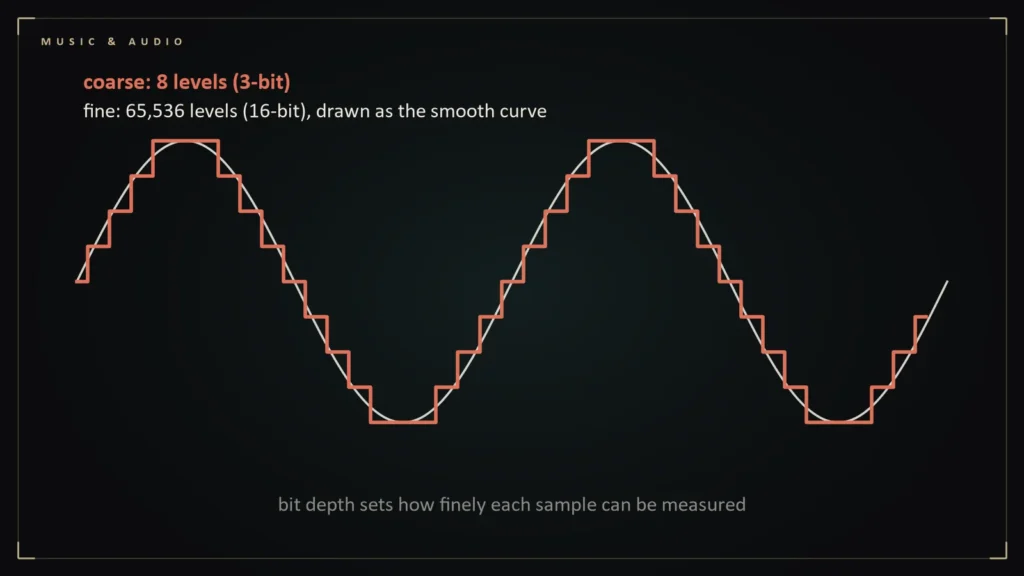
Every digital recording is described by a sample rate and a bit depth. The sample rate says how many times per second the sound is measured; CDs use 44,100 times a second, or 44.1 kHz. The bit depth sets how finely each measurement is recorded and therefore the gap between the quietest and loudest sounds; CDs use 16 bits. Multiply the two by two channels and you get 1,411 kilobits per second, the data rate of an uncompressed CD. That combination, 16-bit/44.1 kHz, is what people mean by “CD quality,” and it is a very good place to listen from.
What “hi-res” adds
Hi-res audio just turns both knobs up: 24-bit depth and sample rates of 96 or 192 kHz. The extra headroom and lower noise floor matter most in the studio, where there is room to process a recording, and in quiet, wide-dynamic-range music like classical and acoustic work. On ordinary headphones in a living room, the step from well-made CD quality to hi-res is subtle. The honest advice is to buy hi-res when it is on offer and not to pay a large premium for it.
The formats you will meet
| Format | What it is |
|---|---|
| FLAC | Compressed lossless. Smaller files, strong tag support, open and royalty-free [1]. |
| WAV | Uncompressed lossless. Opens nearly everywhere; weaker tags. |
| ALAC | Apple’s compressed lossless format; the one Apple’s apps prefer. |
| AIFF | Apple’s uncompressed counterpart to WAV. |
Deciding between the two most common? Our WAV vs FLAC guide breaks it down.
Why lossless is worth owning
Streaming defaults to compressed audio, and even the lossless tiers work only while the subscription does. A downloaded lossless file is a permanent, full-quality copy that plays offline. That is why every Godlike album is sold as lossless WAV and hi-res FLAC downloads you own outright, with free previews on each track in the discography.
Questions readers ask
Is CD quality good enough, or do I need hi-res?
For most listening, CD-quality lossless (16-bit/44.1 kHz) is more than enough; hi-res matters mostly for critical listening and production.
What does lossless mean?
It means the format keeps all the audio data. A lossless file decodes to the same sound as the original, which is how FLAC is designed [1].
Does lossless take more storage?
Yes. Lossless files are larger than MP3s of the same track, and hi-res files are larger still.
References
- FLAC FAQ — Xiph.Org Foundation — https://xiph.org/flac/faq.html