How to Read a Physics Headline: Sigma, Certainty and the Word “Breakthrough”
Five sigma means one chance in 3.5 million of a fluke. DESI's 4.2, MicroBooNE's 95% and GW250114's 99.999% explained, so you can judge the next claim.
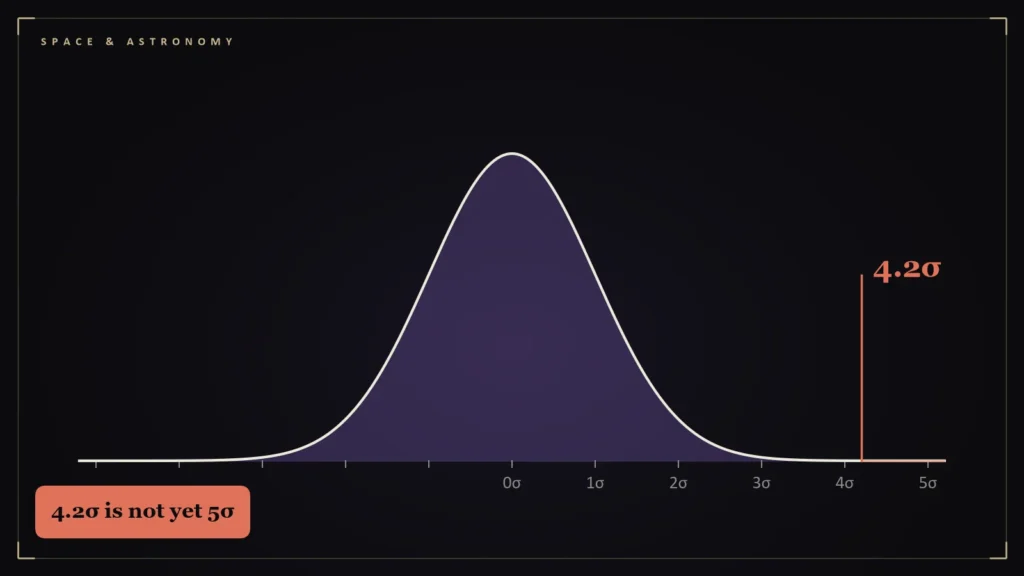
Every few months a headline announces that physics has been overturned, and every few months physics carries on. A little numeracy makes you much harder to fool, and the numbers are easier than they look.
- Five sigma corresponds to about one chance in 3.5 million of being a fluke in the background noise, the usual bar for a discovery in particle physics [1].
- Three sigma is about one chance in 750, yet a widely quoted rule of thumb says half of all three-sigma results turn out to be wrong [1].
- DESI’s evidence for evolving dark energy reached 2.8 to 4.2 sigma, short of five [2].
- MicroBooNE excluded a sterile neutrino at 95 percent, while GW250114 confirmed the area theorem at 99.999 percent; these are different kinds of claim [3][4].
What a sigma is
A sigma is a standard deviation: a measure of how far a result sits from what pure chance would produce. Five sigma, the usual discovery threshold in particle physics, corresponds to roughly one chance in 3.5 million that the signal is just an unlucky fluctuation of the background noise [1]. Three sigma, often treated as “evidence,” is only about one chance in 750 [1].
Why the bar is so high
Because physicists have been burned. A widely quoted rule of thumb, repeated in a blog post by Andrew Jaffe, is that half of all three-sigma results turn out to be wrong, because stated errors often ignore systematic effects, exciting results get more attention than dull confirmations, and new results tend to lose significance as more data accumulate [1]. A sigma level is the best case, not a guarantee.
Three recent claims, three different questions
- DESI, dark energy: 2.8 to 4.2 sigma that dark energy is evolving, depending on the data combined; the collaboration’s own members say this falls short of a five-sigma discovery [2].
- MicroBooNE, sterile neutrinos: 95 percent certainty that a single sterile neutrino cannot explain old anomalies [3]. That is an exclusion, a statement about what is not there, rather than a claim of something new.
- GW250114, Hawking’s area theorem: confirmed at 99.999 percent, versus 95 percent in 2015 [4]. This is a test of a well-defined prediction, with a much cleaner signal.
The sigma table, computed
Sigma levels translate to odds with a simple formula. For a one-sided test, 3 sigma corresponds to about 1 chance in 741, 4.2 sigma to about 1 in 74,930, 2.8 sigma to about 1 in 391 and 5 sigma to about 1 in 3,488,556 (my calculation), which matches the one-in-3.5-million and one-in-750 figures in the sources [1]. DESI’s range of 2.8 to 4.2 sigma therefore spans odds of roughly 1 in 400 to 1 in 75,000, a wide band that is the reason the claim is described as evidence, not discovery [2].
Two practical points follow from the sources. The maxim that half of all three-sigma results turn out wrong is, in the words of the post I used, widely believed but unsourced, so it is better held as folklore than as a statistic [1]. And the MicroBooNE result rests on 60 percent of the data collected and a collaboration of 193 scientists, which shows the other route to confidence: more data and independent analysis, not a bigger number on one headline [3].
A reader’s checklist
- What exactly is the claim: something exists, something does not, or a theory held up?
- What is the significance, and does it reach five sigma for a discovery claim?
- Have independent datasets or teams confirmed it?
- Does the headline say “breakthrough” where the paper says “hint”?
The word that matters most in science news is usually the verb. “Suggests” means a hint. “Confirms” means a test passed. “Proves” almost never appears in a good paper.
Questions readers ask
What does five sigma mean?
About a one-in-3.5-million chance that a result is a random fluctuation; it is the standard bar for a discovery in particle physics [1].
Is three sigma good enough to claim a discovery?
Usually only as ‘evidence’; three-sigma effects often fade as more data arrive [1].
References
- One Chance in 3.5 Million — Andrew Jaffe — https://andrewjaffe.net/blog/2011/08/one_chance_in_3/
- Evidence Mounts for Evolving Dark Energy, DESI Results Find — University of Texas at Dallas — https://news.utdallas.edu/science-technology/desi-results-dark-energy-2025
- MicroBooNE Finds No Evidence for a Sterile Neutrino — Fermilab — https://news.fnal.gov/2025/12/microboone-finds-no-evidence-for-a-sterile-neutrino/
- Ten years after the discovery, gravitational waves verify Stephen Hawking's black hole area theorem — IFAE — https://www.ifae.es/news/2025/09/10/ten-years-after-the-discovery-gravitational-waves-verify-stephen-hawkings-black-hole-area-theorem/