What a Margin of Error Really Means, Using Real 2026 Polls
Pew's 3,554 adults, Marist's 1,591 (plus or minus 2.8) and a 1,000-voter poll (plus or minus 3.1): how sample size sets the margin and what it leaves out.
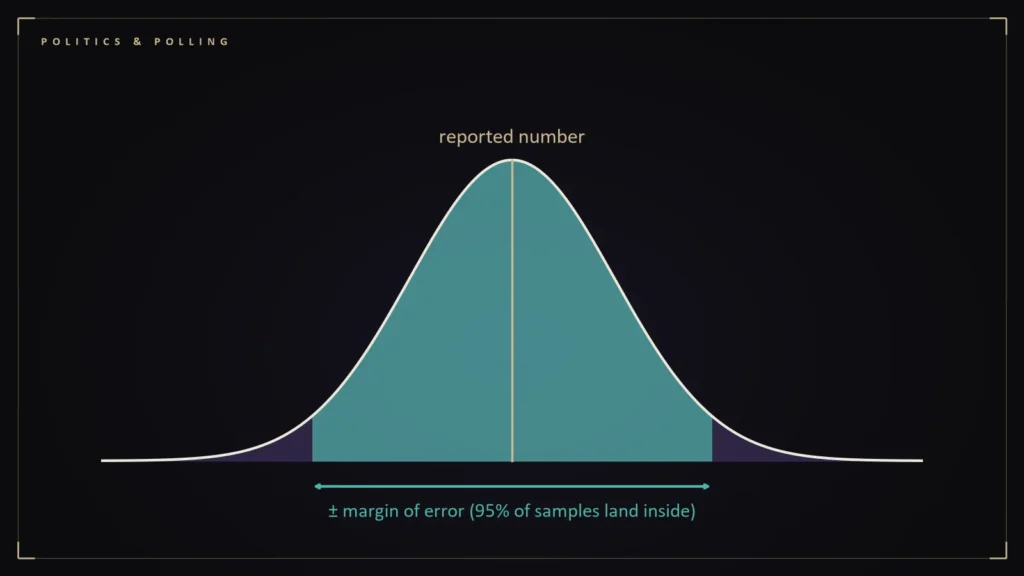
Every poll story contains a sentence like “the margin of error is plus or minus three points,” and almost nobody explains what it covers. Using four real 2026-era surveys, here is the short version.
- A poll’s margin of error shrinks with the square root of the sample, not the sample itself: 1,000 respondents gives roughly plus or minus 3.1 points at 95 percent confidence [1].
- Marist’s March 2026 poll of 1,591 adults reported plus or minus 2.8 points [2], while Pew’s 3,554-adult July 2026 survey used a large probability-based panel [3].
- A non-probability online sample, such as the 1,552-adult GPAHE survey, does not support the standard margin-of-error claim [4].
- The margin covers sampling noise only, not bad wording or an unrepresentative sample.
Where the number comes from
For a simple random sample, the margin of error at 95 percent confidence is about 1.96 times the square root of p(1-p)/n, which for a 50-50 question works out to roughly 98 divided by the square root of the sample size. With 1,000 respondents that gives about 3.1 points, exactly what the Leadership Conference reported for its 1,000-likely-voter poll [1]. To halve the margin you must quadruple the sample.
Why Marist says 2.8 and not 2.5
The same formula for Marist’s 1,591 adults would give about 2.5 points. Marist reported plus or minus 2.8 [2]. The difference comes from weighting: real surveys adjust their data to match the population, and weighting adds variance, which pollsters fold into a larger stated margin. The number you see is therefore an honest adjustment, not a mistake.
Big panels, different rules
Pew’s July 2026 survey on election confidence drew on 3,554 adults from its American Trends Panel [3]. A larger probability-based sample like this narrows the sampling error, but the usual caveats still apply to question wording and to how people answer.
When there is no margin to report
The GPAHE voting-fears survey interviewed 1,552 adults online with demographic quotas, a non-probability design [4]. Because respondents were not randomly selected, a conventional margin of error cannot be computed, and its figures should be read as indicative [4].
The simple-random-sample table
Using the rule of thumb of about 98 divided by the square root of the sample size, the margin for a simple random sample at 95 percent confidence works out as follows (my arithmetic, not any pollster’s published figure):
| Sample size | Approximate margin (points) |
|---|---|
| 500 | ±4.4 |
| 1,000 | ±3.1 |
| 1,552 | ±2.5 |
| 1,591 | ±2.5 |
| 2,000 | ±2.2 |
| 3,554 | ±1.6 |
Quadrupling the sample only halves the margin, which is why pollsters stop at a thousand or two. The table also shows why published margins can differ from the formula: weighting, clustering and panel design change the effective sample size, which is the reason Marist reports 2.8 points for 1,591 adults [2]. The 1,552-adult GPAHE poll does not get a margin at all, because its sample is not a probability sample [4].
What the margin never covers
- Wording. “Support” and “approve” are not identical.
- Who answers. People who respond are not always like those who do not.
- Subgroups. The margin for “Republicans” or “adults 65 and older” is larger than the overall margin because their samples are smaller.
- Timing. A poll is true as of its field dates.
The practical rule: a 2-point difference between two results is noise. A 10-point shift across good polls is news.
Questions readers ask
What does a margin of error of plus or minus 3 points mean?
For a probability sample, the true value is likely within 3 points of the reported figure 95 percent of the time, covering sampling error only [1].
Do all polls have a margin of error?
Not in the conventional sense: non-probability online samples, like the GPAHE survey, do not support a standard margin of error [4].
References
- Civil Rights Monitor Poll 2024 — The Leadership Conference on Civil and Human Rights — https://civilrights.org/2024/10/07/civil-rights-monitor-poll-2024/
- Election Security, March 2026 — NPR/PBS News/Marist Poll — https://maristpoll.marist.edu/polls/election-security-march-2026/
- How confident are Americans in the midterm elections' fairness and accuracy? — Pew Research Center — https://www.pewresearch.org/short-reads/2026/08/05/how-confident-are-americans-in-the-midterm-elections-fairness-and-accuracy/
- Americans Have Significant Fears About Voting: Survey 2026 — Global Project Against Hate and Extremism — https://globalextremism.org/post/americans-have-significant-fears-about-voting-survey-2026/