Ground Troops: The One Question Polls Answer the Same Way
Economist/YouGov found 14% favor ground troops in Iran and 62% oppose. Quinnipiac and Reuters-Ipsos show the same pattern, even among Republicans.
Polls about wars are usually a tangle of definitions. The question of ground troops is the exception: it produces a result so lopsided that the pollster barely matters.
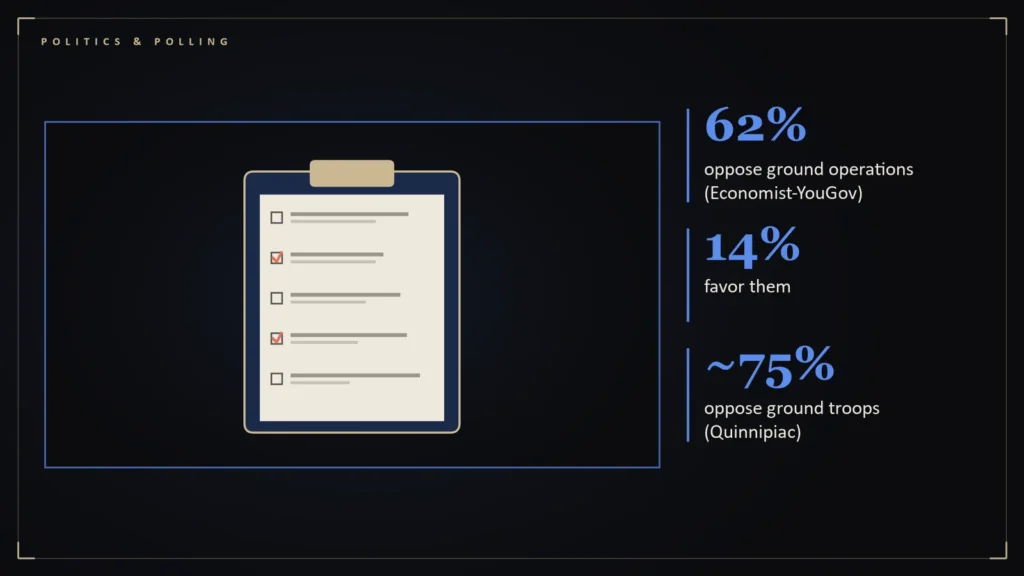
- An Economist-YouGov poll found 14 percent of Americans favor ground operations in Iran and 62 percent oppose [1].
- Reuters-Ipsos found support topping out near 40 percent when limited special-forces deployment was an option, while 55 percent opposed any ground troops [1].
- Quinnipiac found roughly 75 percent opposed to sending ground troops and about 20 percent in favor, taken after six service member deaths were announced [2].
- Among Republicans, opposition still outweighed support in the polls cited, though by narrower margins [1][2].
The headline numbers
In a March 2026 Economist-YouGov survey, 14 percent of Americans favored sending U.S. ground troops into Iran, while 62 percent opposed the idea and 24 percent were not sure. Other pollsters, including Ipsos and AP-NORC, found similar patterns, with opposition outpacing support by more than four to one [1].
Reuters-Ipsos tested a subtler version. When respondents could choose limited special-forces deployments, support reached a ceiling near 40 percent, yet 55 percent still opposed any ground troops whatsoever [1].
After the first casualties
Quinnipiac asked after six service member deaths were announced. About 75 percent of voters opposed ground troops and about 20 percent supported them [2]. Among Republicans specifically, 52 percent opposed and 37 percent favored, a narrower gap than among all voters [2].
Inside the president’s coalition
The partisan detail is the most interesting part. Even among Republicans, more opposed than supported ground deployment in the Economist-YouGov data, 37 percent versus 30 percent, and among self-identified MAGA supporters support stood at 41 percent with 27 percent opposed [1]. Tepid backing, not enthusiasm, is the pattern across the base.
More of the polling picture
Other pollsters found the same direction. Ipsos and AP-NORC surveys showed opposition outpacing support by more than four to one, and the YouGov breakdown found Republicans split with 37 percent opposed and 30 percent in favor, MAGA supporters at 41 percent in favor against 27 percent opposed, and non-MAGA Republicans 60 percent opposed [1]. Fox News found 58 percent opposed to the current action overall, with 77 percent of Republicans in support (42 percent strongly) and 88 percent of Democrats opposed (65 percent strongly) [2]. Pew found 59 percent calling the decision to use force the wrong one [1].
Casualties changed the mood. In a mid-March Post poll taken after seven deaths and 140 wounded, 37 percent called casualty numbers acceptable and 63 percent did not, a contrast with the Iraq War, when majorities found early casualties acceptable [1]. Early in the war about 4 in 10 Americans supported the strikes and roughly half opposed, with about 1 in 4 expressing no opinion when offered that choice [1]. Nearly 6 in 10 opposed across five recent surveys of more than 10,000 Americans [1]. An Ipsos poll found 66 percent favoring ending involvement quickly even without achieving all goals, against 27 percent who wanted to continue [1], and CBS-YouGov found 92 percent saying ending the conflict quickly was important [1].
The appetite for an exit
The same reporting found 63 percent of Americans in mid-March calling casualty levels unacceptable, and 66 percent preferring to end U.S. involvement quickly even if it meant not achieving all of the country’s goals in Iran [1]. Together, those numbers describe a public that tolerates an operation more than it endorses an escalation.
What polls cannot tell us is how that would change if a specific event, an attack on U.S. forces, for instance, shifted the framing. Opinion on war has historically moved after events. The only safe reading is a snapshot with a date on it.
Questions readers ask
How many Americans support ground troops in Iran?
An Economist-YouGov poll found 14 percent in favor and 62 percent opposed; Quinnipiac found about 20 percent in favor and 75 percent opposed [1][2].
Do Republicans support ground troops?
Polls found more Republicans opposed than in favor, though by narrower margins than among all voters [1][2].
References
- Americans have little appetite for sending U.S. troops to Iran, polls show — Anchorage Daily News — https://www.adn.com/nation-world/2026/04/01/americans-have-little-appetite-for-sending-us-troops-to-iran-polls-show/
- Polls show what Americans think about the war in Iran — PBS NewsHour — https://www.pbs.org/newshour/politics/polls-show-what-americans-think-about-the-war-in-iran.