Who Wears the Zodiac? What the Survey Numbers Say
Roughly 4 in 10 women under 50 believe in astrology, against 2 in 10 men under 50. Pew's demographic data shows who zodiac apparel is really speaking to.
Every product has an imagined customer, and the imagined customer for zodiac clothing is usually a stereotype. The data is more interesting, and it is more useful. Pew Research Center interviewed 9,593 U.S. adults in October 2024 and published the results in May 2025, with the astrology numbers broken out by age, gender and identity [1].
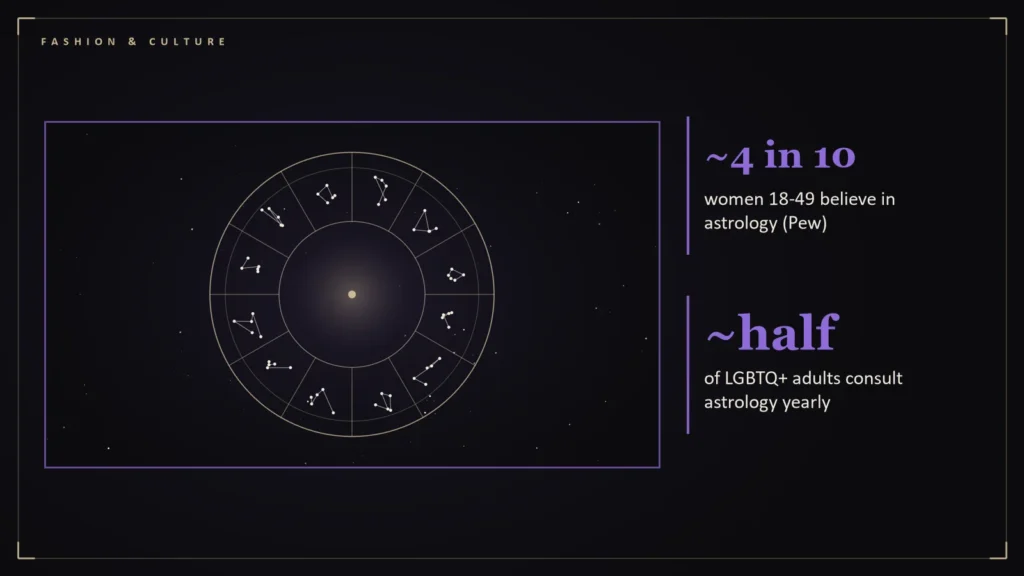
- In Pew’s October 2024 survey, about 4 in 10 women ages 18 to 49 believe in astrology, versus about 3 in 10 women 50 and over and about 2 in 10 men under 50 [1].
- Adults 65 and older are less likely than other age groups to believe in it [1].
- About half of LGBTQ+ adults consult astrology, tarot or fortune tellers yearly, roughly double the rate for adults overall [1].
- These are belief and usage numbers, not purchase data; they describe an audience, not sales.
The center of gravity: women under 50
Belief runs strongest among women ages 18 to 49, at roughly four in ten. Among women 50 and older it falls to about three in ten, and among men under 50 it is about two in ten. Adults 65 and over are less likely than any other group to believe [1]. If you picture a crowd that wears its sign, it skews younger and more female, but the older and male shares are far from zero.
A community with its own habit
The sharpest spike belongs to LGBTQ+ adults, about half of whom consult astrology, tarot or fortune tellers at least once a year, roughly double the rate in the general adult population [1]. For a lot of people, sign talk is not a joke at all; it is a shared language, a way to read each other fast and kindly.
What counts as belief, and what counts as use
The survey is careful about its categories. Pew asked 9,593 U.S. adults in October 2024 about three practices: astrology, tarot cards and fortune tellers [1]. About 27 percent believe in astrology, close to 29 percent in 2017; about 3 in 10 adults use at least one of the practices in a year, about 2 in 10 mostly for fun and about 1 in 10 because they believe it gives helpful insights [1]. Only about 1 percent say they rely on them a lot for major life decisions, and a notably higher share of LGBTQ+ adults, about 2 in 10, rely at least a little on the insights when making significant choices [1].
For a retailer the lesson is that belief, use and reliance are three different audiences. A shopper who buys a zodiac shirt is most likely in the large “for fun” group, not the small group that makes decisions by the stars. The coverage does not detail the exact wording of the belief question or discuss limits of self-reported spiritual practice, so the figures are best treated as a broad outline [1].
What these numbers can and cannot tell a shop
They tell you where interest lives. They do not tell you who buys apparel, how much they spend, or whether a believer prefers a zodiac tee or a quiet gold pendant. Belief is a mood; purchase is a transaction. Treat the survey as a map of the audience’s feelings and let sales data, when you have it, say what they actually do.
One practical lesson survives the caveat. A wide spread of ages and identities shares this vocabulary, so a design that reads as inclusive, curious and a little funny will travel farther than one that speaks to a single stereotype.
Questions readers ask
Which group is most likely to believe in astrology?
In Pew’s October 2024 survey, women ages 18 to 49, at about 4 in 10 [1].
Are older adults less likely to follow astrology?
Yes. Adults 65 and older were less likely than other age groups to believe in it [1].
References
- How many Americans believe in astrology and rely on fortunetelling? — NBC Chicago, reporting Pew Research Center — https://www.nbcchicago.com/news/national-international/how-many-americans-believe-in-astrology-rely-on-fortunetelling/3751055/