Wabi-Sabi, Properly: A Short Guide for People Who Own a Lot of Linen
Wabi-sabi is not a mood board. It comes from Japanese tea culture and means beauty that is imperfect, impermanent and incomplete. Here is what it asks of clothes.
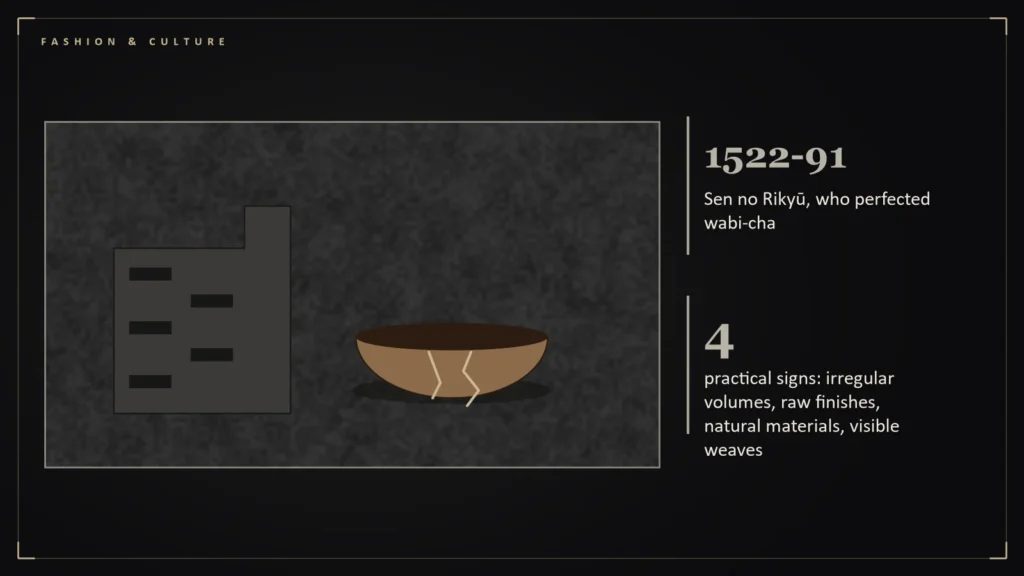
On Pinterest, wabi-sabi is a color palette: oatmeal, stone, faded indigo. In its home culture it is something stricter and more interesting, an attitude toward objects that asks you to love what time does to them.
- Leonard Koren’s book describes wabi-sabi as “the beauty of incomplete, imperfect, impermanent things” [1].
- Tea master Sen no Rikyū (1522-1591) popularized and perfected wabi-cha, building on earlier masters such as Murata Shukō and Takeno Jō-ō [2].
- In fashion, IED lists irregular volumes, raw finishes, natural untreated materials and visible weaves as the practical signs [3].
- The same philosophy raises questions about product longevity and reparability [3].
Where it comes from
Wabi-sabi grew out of Japanese tea culture. The tea master Sen no Rikyū (1522 to 1591) did not invent wabi-cha, the tea tradition built on simplicity. He popularized and perfected it, following his master Takeno Jōō, who in turn built on the groundwork of Murata Shukō (1423 to 1502) [2]. Rikyū formalized four principles still used in the tea ceremony today: harmony, respect, purity and tranquility [2].
The definition that stuck in the West
Leonard Koren’s 1994 book introduced English readers to the idea, summarized as “the beauty of incomplete, imperfect, impermanent things” [1]. The IED breaks the compound word apart: wabi is essential simplicity, and sabi is the value of time and wear [3].
What it looks like on a body
- Irregular volumes and raw finishes, chosen on purpose, not produced by accident [3].
- Natural, untreated materials, such as linen, hemp and raw cotton, with visible weaves [3].
- Recycled or regenerated fabrics that keep traces of a previous life [3].
- Hand or semi-industrial techniques that introduce slight variation from piece to piece [3].
Two words, two ideas
The Italian design school IED breaks the term into two halves. Wabi is essential simplicity, a restrained aesthetic, while sabi is the value of time and the way a material changes through use and wear [3]. It argues that in design, error loses its negative connotation and becomes a possibility, and the process opens to more experimental approaches in which control interacts with the unexpected [3]. In practice that means fabrics in untreated fibers, dyed with natural pigments, or made through artisanal processes that cannot be replicated, which gives each piece its aesthetic and symbolic value [3].
The same article ties the philosophy to responsibility: it raises questions about consumption models, product longevity and reparability, and frames design as a cultural and responsible practice [3]. That is the answer to the linen-closet cliche. A wardrobe is wabi-sabi not because it is beige and wrinkled but because the owner expects the pieces to wear, mend and last. The aesthetic is a consequence of the attitude, not the other way around.
The part most people skip
The truly wabi-sabi move is not buying something with a deliberate flaw. It is owning something long enough that it acquires one. IED notes that the philosophy invites questions about consumption models, longevity and repair [3]. A shirt that gets softer, a seam you mend, a hem that frays slowly: those are the pieces that earn the word. The rest is just a color scheme.
Questions readers ask
Where does wabi-sabi come from?
It developed in Japanese tea culture, where Sen no Rikyū popularized and perfected the wabi-cha tradition [2].
How does wabi-sabi apply to clothing?
Through irregular volumes, raw finishes, natural materials with visible weaves, and an emphasis on longevity and repair [3].
References
- Wabi-Sabi for Artists, Designers, Poets & Philosophers — Leonard Koren (1994), summarized by Poets & Writers — https://www.pw.org/best-books/wabisabi_for_artists_designers_poets_philosophers
- Japanese Tea Ceremony — New World Encyclopedia — https://www.newworldencyclopedia.org/entry/Tea_ceremony
- Wabi-Sabi in Fashion: The Beauty of Imperfection — IED — https://www.ied.edu/news/wabi-sabi-fashion-beauty-imperfection