Artemis II: Four Astronauts, Ten Days, One Loop Around the Moon
Artemis II flew farther from Earth than any humans have, splashed down April 10, 2026 off San Diego, and its heat shield survived 5,000 degrees Fahrenheit.
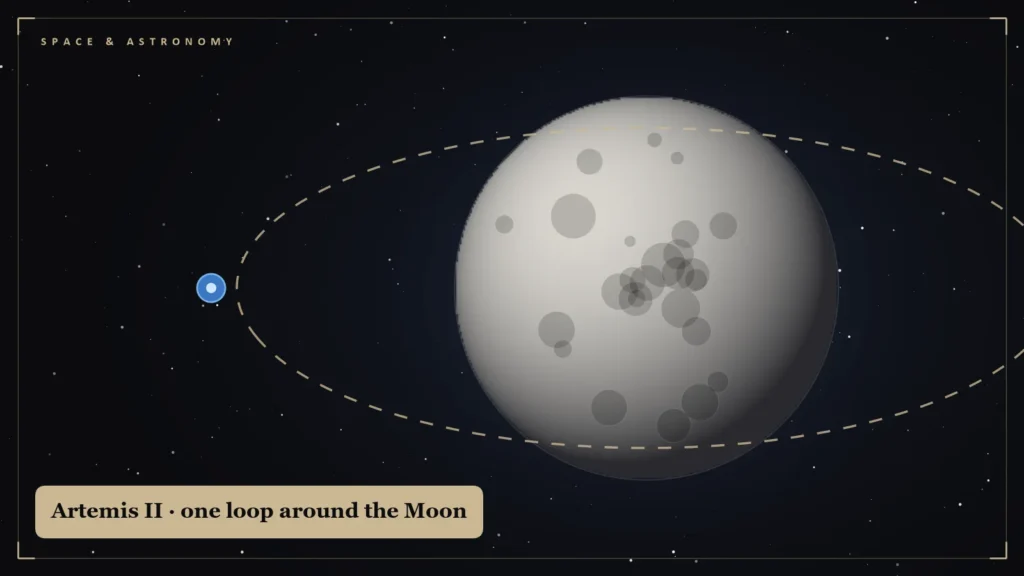
Fifty-three years after Apollo 17, people went back. They did not land, and they were not supposed to. Artemis II was the dress rehearsal that makes everything after it possible, and by every account it went to script.
- Artemis II’s crew of Reid Wiseman, Victor Glover, Christina Koch and Jeremy Hansen flew 10 days around the Moon and splashed down off San Diego on April 10, 2026 [1].
- They traveled farther from Earth than any humans before; Glover and Koch are the first Black man and first woman to leave low Earth orbit, and Hansen is the first non-U.S. citizen to reach the Moon [1].
- Orion’s modified heat shield endured temperatures up to 5,000 degrees Fahrenheit during reentry and performed as designed [1].
- Next: a 2027 low-Earth-orbit test with a lunar lander, then a first crewed landing since Apollo in 2028 [1].
The crew and the loop
Commander Reid Wiseman, pilot Victor Glover, and mission specialists Christina Koch and Jeremy Hansen of the Canadian Space Agency spent ten days in space, looping around the far side of the Moon in the Orion capsule and splashing down in the Pacific off San Diego just after 8 p.m. Eastern on Friday, April 10, 2026 [1]. They traveled farther from Earth than any humans ever have [1].
Firsts, quietly stated
The crew list carries its own milestones. Glover became the first Black man to leave low Earth orbit, Koch the first woman, and Hansen the first non-U.S. citizen to reach the Moon [1]. Koch’s own summary of the meaning was more modest than the headlines: “We will explore. We will build. We will build ships. We will visit again,” she said, while emphasizing that humans will “always choose Earth” [1].
The test that mattered most
The question hanging over the mission was the heat shield. On the uncrewed 2022 test flight, the shield was damaged. This time, the capsule experienced temperatures up to 5,000 degrees Fahrenheit during reentry and the modified shield performed as designed, a significant improvement [1]. For anyone planning to put people in Orion again, that is the sentence that matters.
The return, by the numbers
The Boston Globe’s account of the splashdown includes the engineering detail. Orion splashed down just after 8 p.m. Eastern, less than a mile from its target, after entering the atmosphere at about 400,000 feet at a peak speed of 34,965 feet per second; the crew felt almost four times Earth’s gravity, endured a six-minute radio blackout, and descended under parachutes at about 20 miles an hour before landing [1]. The flight path was within 0.4 percent of the target angle, and the USS John P. Murtha recovered the capsule [1].
Not everything went perfectly. The article notes a valve leak in the service module’s propulsion system, which is exactly the type of issue a test flight is meant to expose [1]. NASA Administrator Jared Isaacman said the agency is back in the business of sending astronauts to the moon and bringing them back safely, and Associate Administrator Amit Kshatriya said the path to the lunar surface is open [1]. The first crewed landing since Apollo is targeted for 2028, with a 2027 low-Earth-orbit test of a lunar lander beforehand [1].
What comes next
NASA’s plan is a 2027 mission in low Earth orbit to test docking with a lunar lander, followed by the first crewed lunar landing since 1972 in 2028 [1]. Schedules in spaceflight bend, and the interval between a successful rehearsal and opening night is always where the surprises hide. For now, four people flew around the Moon and came home, and the program that sent them is on the road to the surface.
Questions readers ask
Who flew on Artemis II?
Commander Reid Wiseman, pilot Victor Glover, and mission specialists Christina Koch and Jeremy Hansen of the Canadian Space Agency [1].
When did Artemis II land?
It splashed down in the Pacific off San Diego on Friday, April 10, 2026 [1].
References
- Artemis II Splashes Down Safely After Voyage Around the Moon — The Boston Globe — https://www.bostonglobe.com/2026/04/10/nation/artemis-ii-splashes-down-safely-voyage-around-the-moon