The September Equinox: Why Day and Night Nearly Match
At the September equinox the Sun sits above the equator and the day-night line runs pole to pole. NASA explains the 23.5-degree tilt behind the seasons.
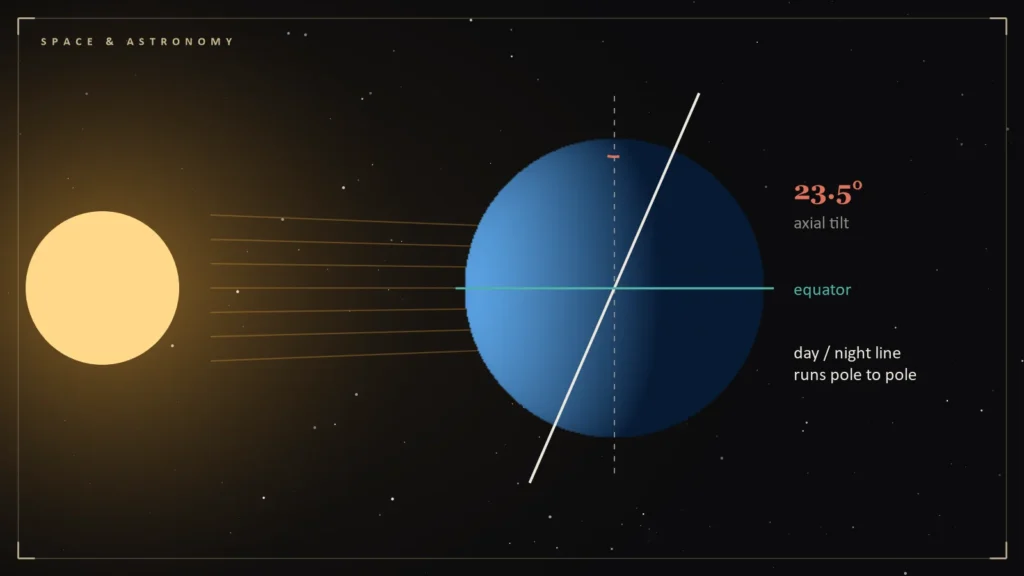
Twice a year the planet stands upright against the Sun, like a spinning top caught perfectly balanced. The September equinox is one of those moments, and it falls around September 22 or 23, depending on the year and the time zone.
- ‘Equinox’ means ‘equal night’ in Latin, the idea that day and night are about equal in length everywhere [1].
- Earth’s axis is tilted 23.5 degrees relative to the Sun and the ecliptic plane [1].
- At the equinox the terminator, the line between night and day, is a straight north-south line and the Sun sits directly above the equator [1].
- Day and night are not perfectly equal because of twilight, when sunlight still lights the atmosphere beyond the horizon [1].
The tilt behind the seasons
NASA’s Earth Observatory explains that the axis of the Earth is tilted 23.5 degrees relative to the Sun and the ecliptic plane. The tilt is why we have seasons: the axis points away from the Sun at the December solstice and toward it at the June solstice [1].
What happens at the equinox
At an equinox the tilt is neither toward nor away. The terminator, the line between night and day, becomes a straight north-south line, and the Sun is said to sit directly above the equator [1]. Seen from space, the dividing line passes through both poles, so both hemispheres get nearly the same sunlight. The Latin word means “equal night,” and the idea is that day and night are equal lengths everywhere on the planet [1].
Not quite equal
NASA notes the statement is true of the Sun’s presence above the horizon but does not account for twilight, when sunlight extends beyond the horizon to light the atmosphere [1]. In practice, day feels slightly longer than night around the equinox.
How the images were made, and a calculation
NASA’s Earth Observatory explains the pictures in that explainer: they were made from EUMETSAT data of the Earth’s full disk taken at the solstices and equinoxes, with images and animation by Robert Simmon, covering September 19, 2010 to September 19, 2011 [1]. In the autumn-equinox frame the terminator is a straight north-south line. At the December solstice the axis points away from the Sun and at the June solstice toward it, which is why the line of day and night tilts in those frames [1].
The twilight caveat can be put in minutes. By the usual definition, sunrise and sunset occur when the Sun’s upper edge touches the horizon, after atmospheric refraction, which corresponds to the Sun’s center being 0.833 degrees below the horizon. At latitude 40 degrees north on the equinox, that gives a day about 9 minutes longer than 12 hours (my calculation with the standard sunrise equation), before counting any twilight [1]. At higher latitudes the difference grows, which is part of why the equinox date for equal day and night varies by place.
How to notice it
- Sunrise and sunset move fastest. The daily change in daylight length is greatest around the equinoxes in mid-latitudes.
- The Sun rises almost due east and sets almost due west.
- The season flips. Autumn begins in the Northern Hemisphere and spring in the Southern.
The exact moment changes every year, so check an almanac for your time zone.
Questions readers ask
Are day and night exactly equal on the equinox?
Not quite. Twilight, when sunlight lights the atmosphere beyond the horizon, makes the day feel slightly longer than the night [1].
Why do we have seasons?
Because Earth’s axis is tilted 23.5 degrees relative to the Sun and the ecliptic plane [1].
References
- Seeing Equinoxes and Solstices from Space, NASA Earth Observatory — https://science.nasa.gov/earth/earth-observatory/seeing-equinoxes-and-solstices-from-space-52248