The Real Wabi-Sabi Is Repair: Imperfection as a Sustainability Strategy
IED argues wabi-sabi raises hard questions about consumption, longevity and repair. The most honest version of the style is a garment you mend.
Fashion has found a way to sell wabi-sabi as a trend: pre-faded, pre-wrinkled, pre-distressed. That is about as faithful to the philosophy as a plastic plant is to a garden. The real thing takes time, and the main ingredient is that you keep the clothes.
- IED says wabi-sabi in fashion prompts questions about consumption models, product longevity and reparability [1].
- Its practical vocabulary includes recycled or regenerated materials that keep traces of their past, and hand or semi-industrial techniques that introduce variation [1].
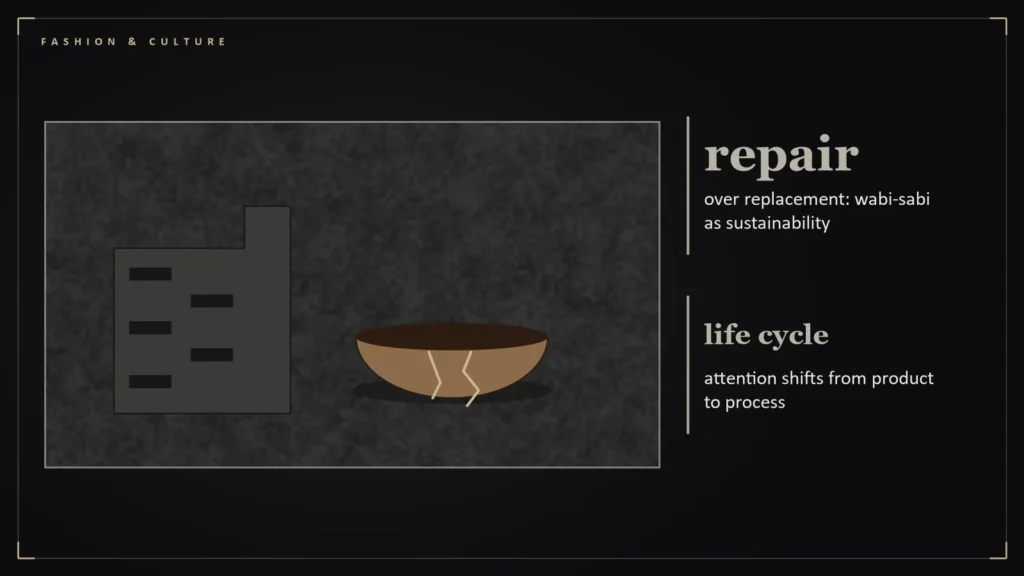
- The philosophy shifts attention from the finished product to the process and the life cycle of the object [1].
- A visibly mended garment is the clearest expression of the idea.
What the philosophy actually asks
IED defines wabi-sabi in fashion as “an aesthetic vision that recognizes value in imperfection, transience, and the marks of time,” and notes that it prompts questions about “consumption models, product longevity, and reparability” [1]. The design principles that follow are practical: irregular volumes and raw finishes, untreated natural materials, visible weaves, recycled or regenerated fabrics that retain traces of a previous use, and manual or semi-industrial techniques that introduce variation [1]. In IED’s framing, design becomes a cultural and responsible practice, with greater attention to processes and to an object’s life cycle [1].
Repair as the honest aesthetic
Read that list as a shopper and a very plain takeaway follows. If imperfection and the marks of time are the point, then the best-looking wabi-sabi garment is one that has been worn, washed, mended and worn again. A patched knee, a darned sweater, a reinforced seam in a contrasting thread: those are not defects hiding in a lookbook. They are the style.
A tradition of mending: boro and sashiko
Japanese textile history supplies a model. The word boro comes from boroboro, meaning something tattered or repaired, and refers to reworking clothing or bedding through piecing, patching and stitching to prolong its life [2]. Basic repairs used running stitches, and sashiko, running stitches sewn through several layers, reinforced worn cloth and quilted layers together [2]. The materials were historically indigo-dyed hemp, with recycled indigo-dyed cotton common later [2].
In the 19th and early 20th centuries, rural families made and wore boro garments, often passing them through several generations, and the practice expressed mottainai, a sense of regret about waste [2]. Museum examples date from about 1850 to 1900, and vintage boro is now valued as art and as a record of daily life [2]. That history is why repair in the wabi-sabi sense is not a trend: it was once ordinary economy, and visible patches were simply the evidence of care.
How to practice it
- Buy fewer, buy better. Choose natural, durable fabrics you can repair.
- Learn three stitches. A running stitch, a whipstitch and a simple darn will save most garments.
- Let mends show. Use a visibly different thread. The repair becomes part of the pattern.
- Wash less, wash cold. Gentler care preserves the cloth.
The result is a wardrobe that looks specific, because it has a history. That is the one thing a trend cannot manufacture.
Questions readers ask
How does wabi-sabi relate to sustainability in fashion?
IED says it prompts questions about consumption models, product longevity and reparability, shifting attention to processes and the life cycle of objects [1].
References
- Wabi-Sabi in Fashion: The Beauty of Imperfection — IED — https://www.ied.edu/news/wabi-sabi-fashion-beauty-imperfection
- Make your own: Japanese 'Boro' bag, Victoria and Albert Museum — https://www.vam.ac.uk/articles/make-your-own-japanese-boro-bag