Absolute Pitch: How Common Is ‘Perfect Pitch’ Among Musicians?
A Brazilian study of 200 conservatory students found 4% met a strict absolute pitch test and 14% a looser one, with earlier training linked to higher rates.
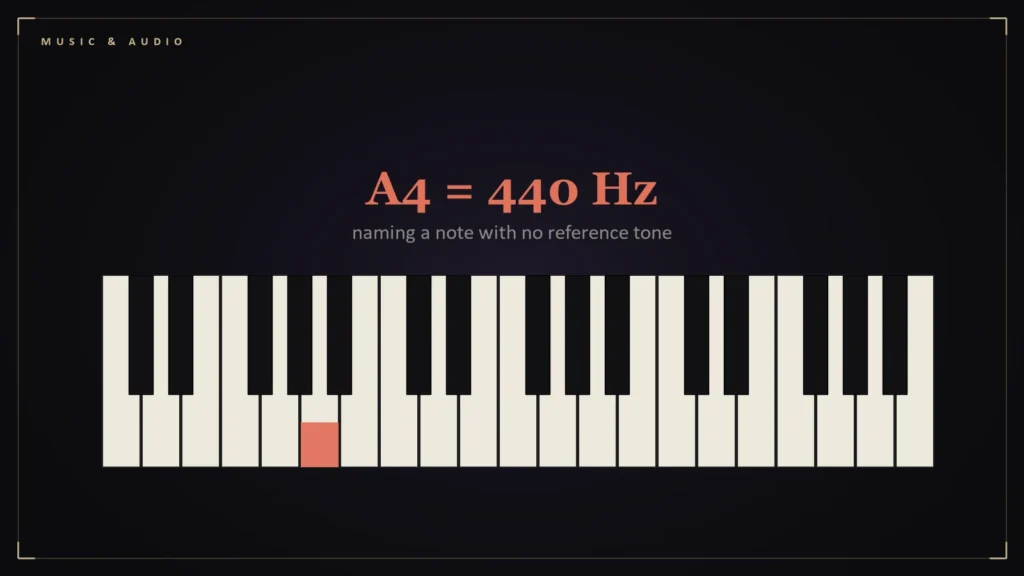
Some people hear a car horn and say “that is an F-sharp.” Most of us cannot. The skill is called absolute pitch, and a large Brazilian study put numbers on how it is distributed.
- Absolute pitch is the ability to identify and name the pitch of a sound without an external reference [1].
- Among 200 conservatory students, 4 percent met a conservative threshold (85 percent correct) and 14 percent an inclusive one (20 percent correct), 18 percent combined [1].
- Among 30 orchestra musicians, 47 percent combined showed absolute pitch (7 percent conservative, 40 percent inclusive) [1].
- Earlier musical training correlated with higher prevalence, and the authors describe absolute pitch as a continuum, not all-or-none [1].
What it is
The paper defines absolute pitch as the ability to identify and name the pitch of a sound without external reference [1]. A musician with relative pitch can name a note once given another; a musician with absolute pitch does not need the first note.
The numbers
The study tested 200 regular conservatory students and 30 orchestra musicians. Using a conservative threshold of 85 percent correct, 4 percent of the students qualified. Using an inclusive threshold of 20 percent correct, 14 percent did, for a combined 18 percent, or 35 of 200 [1]. Among the orchestra musicians, the combined figure was 47 percent, made of 7 percent on the conservative measure and 40 percent on the inclusive [1]. Where you draw the line changes the answer.
Early training
The authors found that earlier musical training correlated with higher prevalence of absolute pitch. Musicians who started before age 7 showed more of it, and those who started between 8 and 11 showed elevated rates compared with later starters [1]. Few participants in the sample had formal education before age 7, so those subgroups are small [1].
A continuum, not a switch
The study concludes that absolute pitch exists on a continuum rather than as an all-or-none ability, and that music proficiency appears associated with better pitch identification [1]. Self-reported absolute pitch was 3.5 percent, which significantly underestimated measured ability [1]. People often do not know what they can do until they are tested.
Self-report versus the test
The study also asked students whether they have the ability, and the answers did not line up with performance. Self-reported prevalence was 3.5 percent, close to the conservative group, but the people who said yes were not the same people who passed the pitch-naming test: of 32 students who said no and were counted as having the ability by the test, 29 were false negatives (90 percent), while 4 of 162 who said yes without passing were false positives (2.5 percent) [1]. Most of those false negatives belonged to the inclusive group (24 of 29) [1]. Self-assessment therefore missed most of the partial ability that a test could find.
Several things did not predict the result. Prevalence did not differ significantly between men (19 percent) and women (15 percent), nor by age, nor by daily hours of practice in the past year [1]. Performance was a continuum: students with low scores named white-key notes more accurately than black-key notes, and the inclusive group’s wrong answers fell closer to the correct pitch than the non-possessors’ did [1]. The 18 percent total was 35 of 200 subjects, the rest performing near chance [1].
Caveats
- One population. Results come from Brazilian musicians and may not apply everywhere.
- Correlation, not proof. Early training and absolute pitch are linked; the study does not settle cause.
- Test design matters. The two thresholds produced very different prevalences.
Questions readers ask
What is absolute pitch?
The ability to identify and name the pitch of a sound without an external reference [1].
How common is absolute pitch in musicians?
In one study of 200 conservatory students, 4 to 14 percent qualified depending on the threshold, 18 percent combined; among orchestra musicians it was 47 percent combined [1].
References
- Music Proficiency and Quantification of Absolute Pitch: A Large-Scale Study among Brazilian Musicians, PubMed Central — https://pmc.ncbi.nlm.nih.gov/articles/PMC5061754/