382 Kilograms of Moon: The Apollo Samples and What They Still Teach
Six Apollo missions returned 382 kilograms (842 pounds) of Moon rock, about 2,200 samples. NASA still lends roughly 400 a year to researchers.
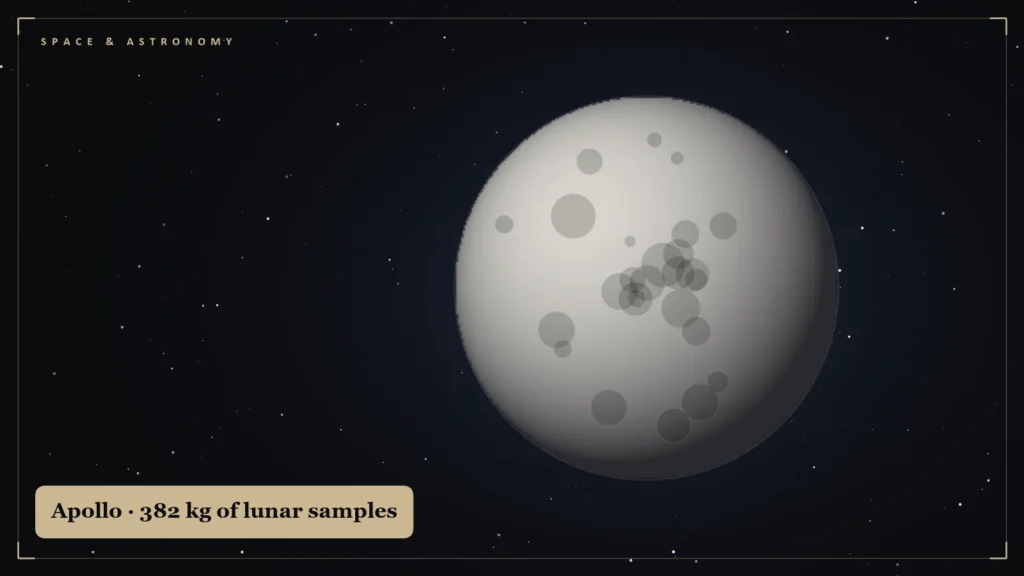
The most valuable souvenirs ever brought home weigh about as much as a grand piano. They sit in a building in Houston, handled by gloved hands, and scientists are still learning from them more than half a century later.
- Between 1969 and 1972 six Apollo missions brought back 382 kilograms (842 pounds) of lunar material [1].
- The six flights returned 2,200 separate samples from six exploration sites [1].
- The lunar sample building at Johnson Space Center is the chief repository, and approximately 400 samples are distributed each year for research and education [1].
- Studies have shown the Moon’s crust formed 4.4 billion years ago [1].
What came back
NASA’s Astromaterials Curation office reports that between 1969 and 1972 six Apollo missions brought back 382 kilograms, or 842 pounds, of lunar material. The six flights returned 2,200 separate samples from six different sites on the Moon [1]. Spread evenly, that is on the order of 170 grams a sample, though real samples vary enormously from dust to large rocks.
Where they live
The lunar sample building at Johnson Space Center in Houston is the chief repository for the Apollo samples [1]. The laboratory prepares pristine specimens for shipment to scientists and educators, and approximately 400 samples are distributed each year [1]. The collection is deliberately rationed so that new instruments, not yet invented, can study material that has been kept clean.
What the rocks say
NASA says studying the rocks and soil continues to reveal information about lunar history, the formation of early Earth and the inner solar system. Scientists have determined that the Moon’s crust formed 4.4 billion years ago and have used the samples’ chemical composition to support theories of how planets formed [1]. Think of each rock as a page from a diary that only the Moon kept.
Not only American
Three Soviet robotic spacecraft separately returned 300 grams from three other lunar sites, which supplements the Apollo collection [1].
Handling the samples
The curators’ laboratory tour explains how the collection is kept. The Lunar Sample Laboratory Facility, built in 1979, is the chief repository for the Apollo samples and was constructed to provide permanent storage in a physically secure and non-contaminating environment [1]. It includes storage vaults, laboratories for preparation and study, a vault for sample data and records, and machinery supplying nitrogen to the cabinets where the samples are stored and processed [1].
Visitors on the tour must follow strict rules: they wipe their shoes on the mat, put on overshoes, remove all jewelry and put on protective clothing in a clean change room, because airborne dust is the chief way in which contaminating material reaches the samples [1]. The collection also includes 300 grams, about three-quarters of a pound, from three other lunar sites returned by the Soviet automated spacecraft Luna 16, Luna 20 and Luna 24 [1]. Careful handling, not only the original return, is what keeps the samples useful.
Why the long view matters
- Patience pays. Keeping samples sealed lets future scientists use better tools.
- One source, many questions. The same rocks serve studies of age, chemistry and impacts.
- Numbers to remember: six missions, 382 kg, about 2,200 samples.
Questions readers ask
How much Moon rock did Apollo bring back?
Six missions between 1969 and 1972 returned 382 kilograms (842 pounds), in about 2,200 separate samples [1].
Where are the Apollo samples kept?
The lunar sample building at NASA’s Johnson Space Center is the chief repository [1].
References
- Lunar Rocks and Soils from Apollo Missions, NASA Astromaterials Curation — https://curator.jsc.nasa.gov/lunar/