How Noise-Cancelling Headphones Work, and Where They Struggle
Active noise cancellation adds an inverted copy of ambient sound to cancel it. A study found it works best below 1 kHz and weakens as noise passes 70 dB.
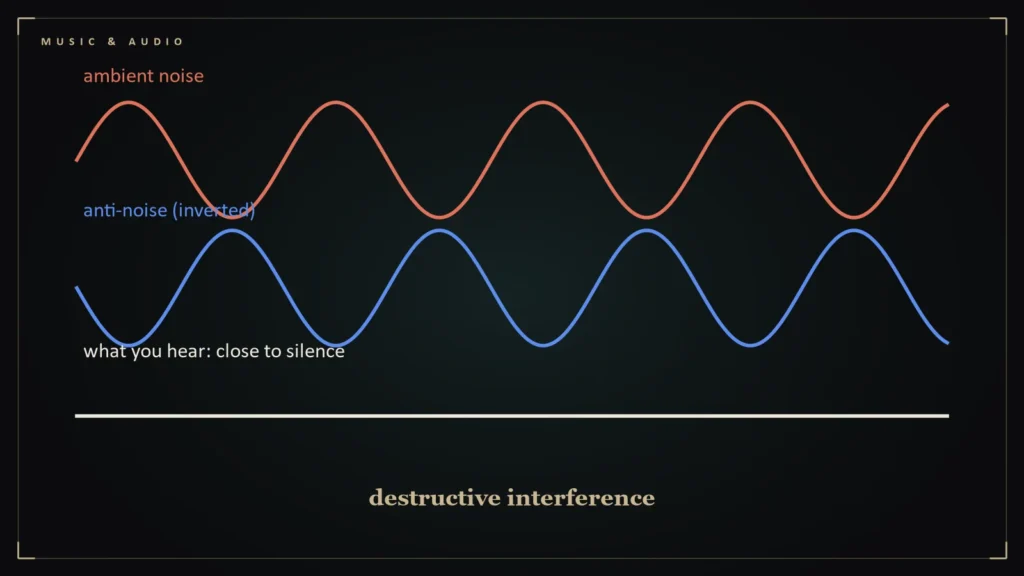
Noise cancellation is the audio equivalent of writing a minus sign. The headphones listen to the world, flip the sound upside down and play it back, so that the room’s hum meets its own mirror image and nothing is left.
- Active noise cancellation generates anti-noise equal in magnitude and opposite in phase to the ambient noise, producing destructive interference [1].
- Feedforward systems use an outside reference microphone; feedback systems use a microphone inside the ear canal [1].
- Current ANC headphones show good cancellation for low-frequency noise below 1 kHz but struggle at higher frequencies [1].
- In one study, signal correlation fell from 83 percent at 50 dB to 63 percent at 60 dB and 46 percent at 70 dB SPL [1].
The principle
A research paper in the PubMed Central archive describes active noise cancellation, or ANC, as estimating the ambient noise through an additional circuit and algorithm, then generating anti-noise with a magnitude equal to and a phase opposite to the ambient noise. Superimposing the two produces destructive interference that reduces the noise [1]. A wave’s peak meeting another wave’s trough is the picture to keep in mind.
Two designs
The paper describes two approaches. A feedforward system takes ambient noise from a reference microphone, usually on the outside of the earcup. A feedback system uses a microphone inside the ear canal as an error sensor, checking what the listener actually hears [1]. Many products combine both.
Where it works and where it does not
The study found that current ANC headphones deliver good cancellation of low-frequency noise, below 1 kHz, but have more trouble with higher frequencies [1]. That is why engine drone fades while a sudden voice or clatter gets through. The technology also works best on steady noise; unsteady noise showed slightly lower effectiveness [1].
The numbers from one study
The research tested ANC headphones in a hearing-screening context, measuring how closely a signal was preserved at different noise levels. Correlation scores were 83 percent at 50 dB SPL, 63 percent at 60 dB and 46 percent at 70 dB, and the authors note that correlation was close to or below 50 percent when noise exceeded 70 dB SPL [1]. These are results for specific headphones in a specific test, so they are an example of the limits, not a rating of every product.
How the test was set up
The authors measured the headphones on a mannequin. The pure test tone and leaked ambient noise mixed in the ear canal and were recorded by the ear-canal microphone of a Kemar mannequin, and the in-canal recordings were analyzed with a correlation coefficient adapted from Pearson’s r [1]. The signals were recorded at 48,000 Hz, split into 32-millisecond frames for a fast Fourier transform, and analyzed over a 0 to 4,000 Hz range, with a high-pass filter at 470 Hz to reduce electrical background noise [1].
A higher coefficient means the target tone survives processing more cleanly, so the correlation measures how well headphones preserve the signal while cancelling noise [1]. That is a narrower question than whether the noise is quieter, which is why the figures in this article describe signal integrity under noise, not listening comfort.
Using this knowledge
- Best for steady rumble. Planes, trains and air conditioning.
- Not a substitute for hearing protection. See the three-decibel rule for safe volume.
- Quiet helps music. Less background noise means you can listen at lower volume.
Questions readers ask
How does active noise cancellation work?
It generates anti-noise of equal magnitude and opposite phase to the ambient noise so the two cancel by destructive interference [1].
Why does noise cancelling work better on low sounds?
In the study, current headphones showed good cancellation for low-frequency noise below 1 kHz but struggled at higher frequencies [1].
References
- Objective Signal Analysis for Investigating Feasibility of Active Noise Cancellation in Hearing Screening, PubMed Central — https://pmc.ncbi.nlm.nih.gov/articles/PMC9572409/