Fifty-Four People Behind Every Curtain: Inside the National Theatre’s Costume Department
The National Theatre's costume department has 54 staff in four areas and supports 20-26 shows a year. How a stage costume goes from sketch to stage.
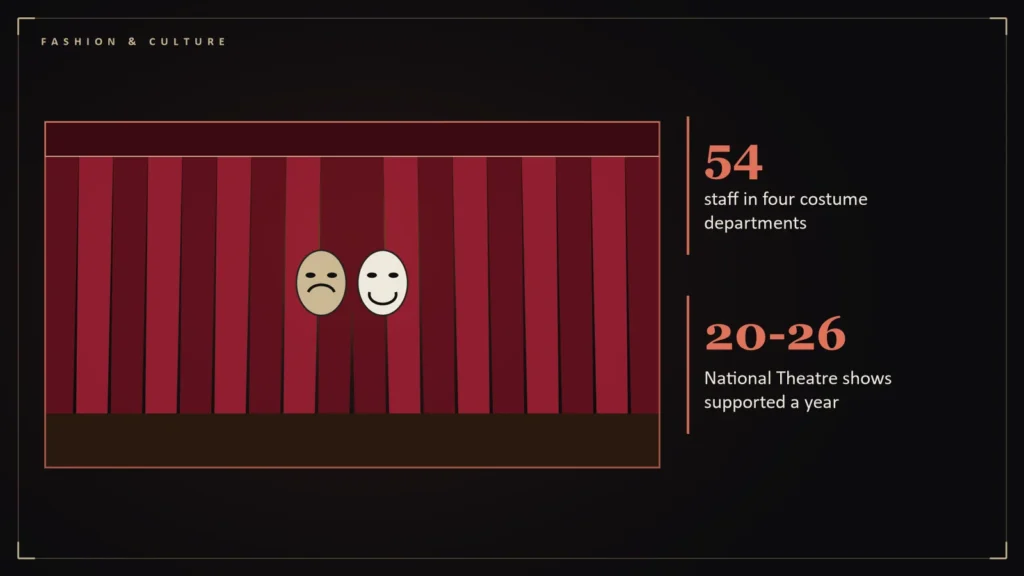
When the curtain rises on a National Theatre production, the first thing the audience reads is a costume, and the people who made it are nowhere in sight. According to a feature on Google Arts & Culture, there are 54 of them [1].
- The National Theatre’s costume department employs 54 staff in four areas: Costume Production, Running Wardrobe, Wigs/Hair/Make-up, and Costume & Prop Hire [1].
- It supports 20 to 26 shows a year at the National, plus West End and touring productions [1].
- Makers balance historical accuracy against the designer’s intent: “We do things to look historically accurate, but also to suit what the designer wants to say about a play” [1].
- Specific techniques include ombre dyeing for faded effects and lycra panels in specialized pieces such as flying corsets [1].
Four departments, one illusion
The costume department is split into four areas: Costume Production, Running Wardrobe, Wigs, Hair and Make-up, and Costume & Prop Hire [1]. It supports 20 to 26 shows each year at the National, plus West End and touring productions [1]. The crafts under that roof are specific and old: tailoring, fabric dyeing and printing, wig-making, costume props, garment construction, hairdressing, alterations, dressing, make-up and show supervision [1].
From sketch to body
A costume does not arrive; it is negotiated. It moves from the designer’s sketches through fittings with designers, tailors and supervisors [1]. One head cutter frames the central tension of the job: “We do things to look historically accurate, but also to suit what the designer wants to say about a play” [1]. The goal is not a museum reconstruction. It is an argument made in fabric.
Costumes that do a job
The National Theatre’s own archive shows how much work a costume does beyond looking right. For The Light Princess (2013), makers built a lycra and plastic-boned corset with hand holds and harness clips so performers could be lifted and manipulated [1]. For Othello (2013), the uniforms were based on those of western troops in Iraq and Afghanistan, with small uniform mistakes given to Iago to reflect his character [1]. The Silver Tassie (2014) used uniforms copied from First World War archive pieces, ombre dyeing to create shadow effects and a “Somme mud” mixture of fuller’s earth, Rosco paint and PVA [1].
Some costumes hide mechanics. The Captain of Köpenick (2013) featured a dancing uniform with a performer hidden behind a black mesh panel, using a frame and manipulating sticks [1]. The props maker Reuben Hart says “As a maker, you’ve got to be very brave, open-minded and confident,” and notes that prototypes are road-tested with actors before tailors fit costumes over them [1]. The senior dyer Liz Honeybone points out that the largest 18th-century dresses were so big they affected furniture and doorways, a reminder that historical accuracy has practical consequences on stage [1].
Tricks you cannot see from Row M
The department’s toolbox is surprisingly inventive. Ombre dyeing creates a convincing faded look. Lycra panels let a flying corset stretch where a real one could not. One piece, the “dancing uniform,” houses a hidden dancer inside the costume itself [1]. Costumes also shape performance: they change how an actor moves, stands and breathes, which is why designers and performers talk long before opening night [1].
That is the part of theater merchandise nobody sells. A program or a poster is a keepsake. A costume is a decision made by 54 people, and the audience feels it without ever knowing their names.
Questions readers ask
How many people work in the National Theatre's costume department?
A Google Arts & Culture feature reports 54 staff across four areas [1].
What techniques do National Theatre costume makers use?
They use methods such as ombre dyeing for faded effects and lycra panels for pieces like flying corsets [1].
References
- Costume at the National Theatre — Google Arts & Culture — https://artsandculture.google.com/story/costume-at-the-national-theatre-national-theatre/UwVxRuA8lwYA8A?hl=en