From the Theatre of 1576 to Irving’s Boots: Where Stage Costume Came From
Britain's first playhouse opened in 1576. Pictorial drama pushed costumes toward historical accuracy. A short, sourced history from the V&A.
Costume is the oldest special effect in theater. Before there were stage lights, a cloak or a crown told the back row who was who. Following the V&A’s account of British theatre gives a quick map of how that visual language grew up.
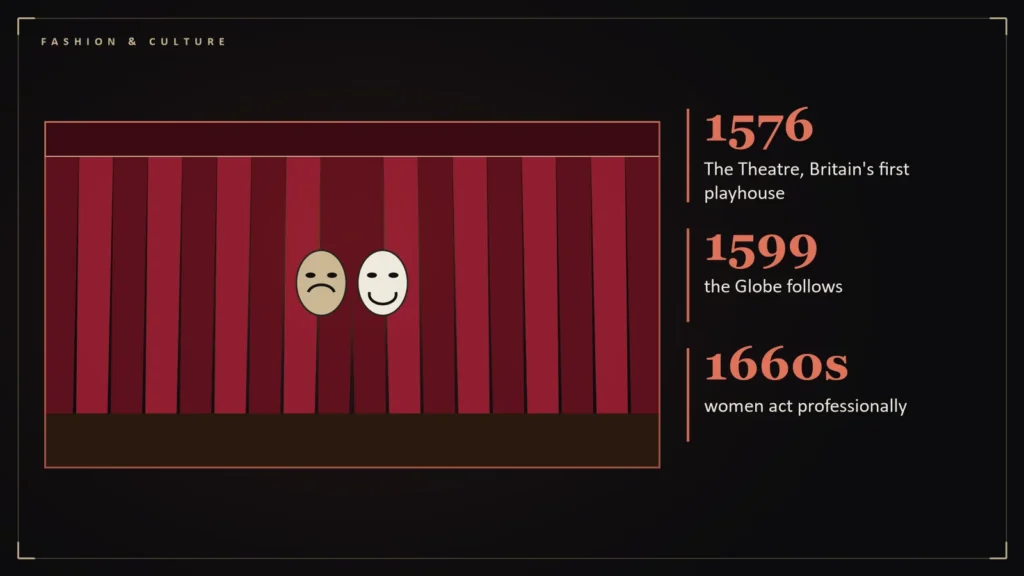
- Britain’s first playhouse, The Theatre, opened in 1576; the Globe followed in 1599 [1].
- Women began acting professionally in the Restoration of the 1660s [1].
- Pictorial drama in the 18th and 19th centuries emphasized historical accuracy in costumes and sets [1].
- The V&A holds Henry Irving’s boots from Richard III (1877), along with playbills, costume designs and set sketches [1].
Playhouses and players
After the Reformation suppressed religious drama in the 16th century, secular theater took off, and Britain’s first dedicated playhouse, The Theatre, opened in 1576. The Globe followed in 1599 [1]. The 1660s Restoration brought women onto the professional stage for the first time [1]. It widened who could be on stage, and with them, who costumes had to be made for.
The age of accuracy
By the 18th and 19th centuries, a style called pictorial drama pushed productions to look historically accurate in both costumes and sets [1]. This is where the modern tension begins: audiences wanted to believe the period, while designers still had to serve the story. It is the same push and pull a National Theatre head cutter describes today, balancing what looks historically correct against what the designer wants a play to say.
Names and dates along the way
The Victoria and Albert Museum’s history gives the cast. Leicester’s Men formed in 1559 and The Theatre was built in Finsbury Fields in 1576, and over the following 16 years 17 more open-air public theatres went up; the Lord Chamberlain’s Men, which William Shakespeare joined in 1594, erected the Globe on the south bank of the Thames in 1599 [1]. Inigo Jones (1573 to 1652) introduced the proscenium arch and moveable scenery, and his collaboration with Ben Jonson on the Masque of Oberon in 1611 reportedly cost £2,000 to stage [1].
Women took the stage after the Restoration: Margaret Hughes (1645 to 1719) is named as the first professional actress in England, appearing in Othello in 1660, and Elizabeth Barry (1658 to 1713) became known as the “queen of tragedy” [1]. In the 19th century Charles Kean (1811 to 1868) pioneered pictorial drama built on historical research, the tradition behind Irving’s accuracy and the boots now in the museum; later, the installation of hydraulic machinery at Drury Lane in 1894 let the designer known as “Sensation” Smith stage elaborate effects [1]. The National Theatre was founded under Laurence Olivier in 1963 and moved to the South Bank in 1976 [1].
Boots in a museum
Some of the best surviving evidence is small. The V&A holds the boots Henry Irving wore as Richard III in 1877, as well as playbills, costume designs and set sketches that trace how productions were imagined [1]. A pair of worn boots is a better record of an actor’s night than a review, because it was there.
From a 1576 playhouse to a modern wardrobe department, costume has always done the same job: tell the audience who a person is before they speak. The materials changed. The promise did not.
Questions readers ask
When did Britain's first playhouse open?
The Theatre opened in 1576, according to the V&A’s history of theatre; the Globe followed in 1599 [1].
When did women start acting professionally in Britain?
In the Restoration period of the 1660s [1].
References
- The Story of Theatre — Victoria and Albert Museum — https://www.vam.ac.uk/articles/the-story-of-theatre