GW250114: The Loudest Gravitational Wave Ever Heard Backs Hawking’s Area Theorem
LIGO's clearest signal yet, GW250114, confirmed Hawking's area theorem at 99.999% confidence after two 30-40 solar-mass black holes merged 1.3 billion light-years away.
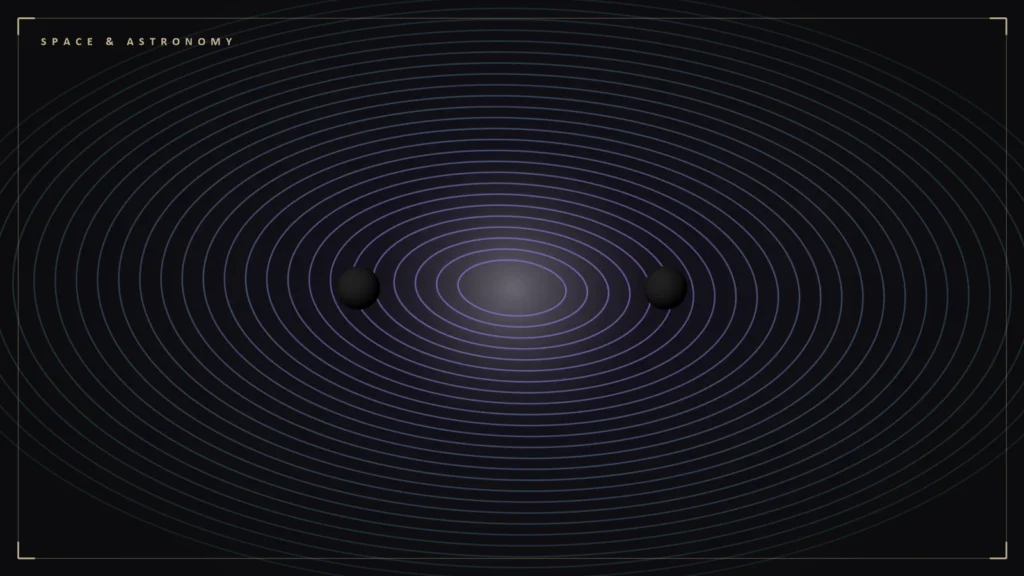
On January 14, 2025, the two LIGO detectors heard a black hole collision more clearly than any signal before it. Ten years of engineering had made the instruments quiet enough to turn a faint chirp into something closer to a clear voice.
- LIGO detected GW250114 on January 14, 2025: two black holes of roughly 30 to 40 solar masses merging about 1.3 billion light-years away [1].
- The merged black hole’s horizon area grew from about 240,000 km² to about 400,000 km², confirming Hawking’s area theorem at 99.999 percent confidence, up from 95 percent in the 2015 test [1].
- For the first time, researchers identified two distinct modes in the ringdown, testing general relativity’s description of the final black hole [1].
- The results were published in Physical Review Letters [1].
A cleaner signal than the first
The signal, GW250114, came from two black holes each between 30 and 40 times the mass of the Sun, merging roughly 1.3 billion light-years away [1]. It was the clearest gravitational-wave detection to date, a dramatic improvement over the first detection in 2015, thanks to a decade of advances that reduced instrument noise [1].
Hawking, confirmed again
Stephen Hawking’s 1971 area theorem says that when black holes merge, the total horizon area can only grow or stay the same, never shrink. GW250114 let physicists measure it: the merged black hole’s surface area increased from about 240,000 square kilometers to about 400,000, which confirms the theorem at 99.999 percent confidence, far above the 95 percent from the 2015 test [1].
The ringdown, in two voices
After two black holes merge, the final one rings like a struck bell. For the first time, researchers identified two distinct gravitational-wave modes in that ringdown, which let them measure the final black hole’s mass and spin precisely and check predictions from general relativity [1]. Giada Caneva Santoro of IFAE, who led the ringdown analysis, described the analysis as “like using a magnifying glass to study the most extreme regions of spacetime” [1].
Why this event was the cleanest yet
The IFAE summary adds measurable context. For GW250114 only the two LIGO detectors were running, because Virgo was in maintenance and KAGRA was offline [1]. The total horizon area before the merger was about 240,000 square kilometers, roughly the size of the United Kingdom, and afterward about 400,000, nearly the size of Sweden; the area-theorem test reached 99.999 percent confidence compared with 95 percent for the first detection, GW150914, on September 14, 2015 [1]. Hawking announced the theorem in 1971 and died in 2018, before it could be tested this way [1].
Detector performance has changed a great deal. The instruments measure changes in space-time smaller than one ten-thousandth of the width of a proton, and the network now sees roughly one black-hole merger every three days, with more than 300 mergers confirmed or awaiting analysis and about 230 candidates from the fourth science run alone, more than the first three runs combined [1]. The ringdown analysis, run with the pyRing code among others, identified two distinct modes with confidence for the first time, and found the ringdown matched what the mathematical models predicted [1]. The collaborations behind these results involve more than 1,600 LIGO scientists, about 1,000 from Virgo and more than 400 from KAGRA [1]. As IFAE student Giada Caneva Santoro put it, analyzing the ringdown is like using a magnifying glass on the most extreme regions of spacetime [1].
Why it is worth the hush
Katerina Chatziioannou of Caltech summarizes what the clearer signal buys: “We can hear it loud and clear, and that lets us test the fundamental laws of physics” [1]. The work, titled “GW250114: Testing Hawking’s Area Law and the Kerr Nature of Black Holes,” appeared in Physical Review Letters [1]. The lesson from the loud signal is that the universe keeps passing its hardest tests, so far, and the detectors are only getting better at asking.
Questions readers ask
What is Hawking's area theorem?
It states that the total event-horizon area of black holes cannot decrease in a merger; GW250114 confirmed it at 99.999 percent confidence [1].
How far away was the GW250114 merger?
About 1.3 billion light-years [1].
References
- Ten years after the discovery, gravitational waves verify Stephen Hawking's black hole area theorem — IFAE — https://www.ifae.es/news/2025/09/10/ten-years-after-the-discovery-gravitational-waves-verify-stephen-hawkings-black-hole-area-theorem/