Voyager 1 Crosses Into Interstellar Space: How We Knew
Voyager 1 crossed the heliopause on August 25, 2012 at about 122 AU, yet scientists confirmed it nearly a year later by listening to plasma oscillations.
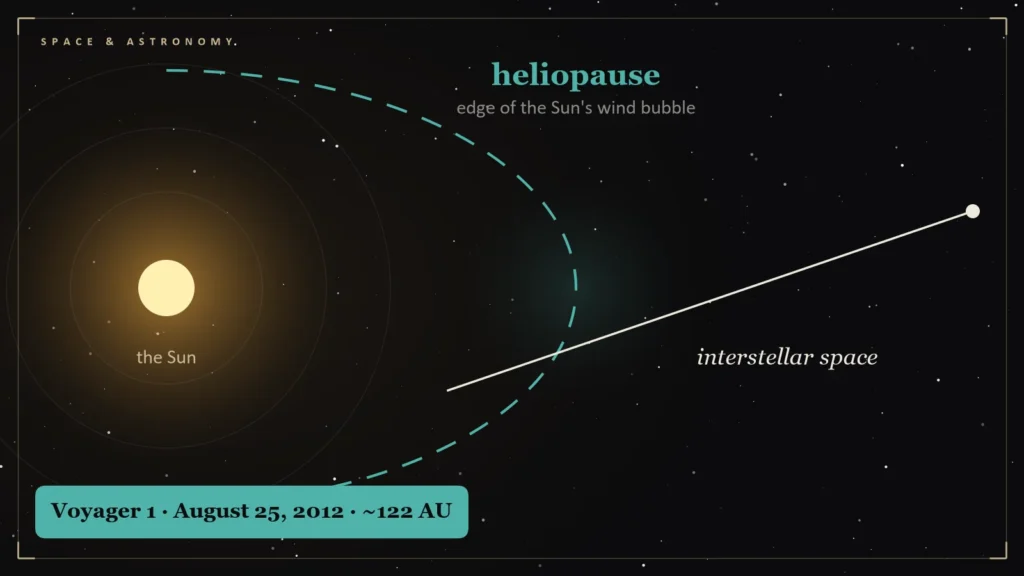
You cannot see a border in space. There is no sign, no line, no change in the view. Voyager 1 crossed the edge of the Sun’s influence in 2012, and humans learned about it by what the spacecraft heard.
- Voyager 1 crossed the heliopause on August 25, 2012, at roughly 122 AU, about 11 billion miles (18 billion km) from the Sun [1].
- Its plasma science instrument had failed in 1980, so confirmation came nearly a year later from the plasma wave subsystem [1].
- Voyager 2 crossed on November 5, 2018, confirmed by both particle and plasma instruments [1].
- The Voyagers are the only human-made objects to reach interstellar space [1].
The border
NASA defines the heliopause as the outer edge of the heliosphere, a protective bubble created by the Sun’s magnetic field and the outward flow of the solar wind [1]. Voyager 1 crossed it on August 25, 2012, at about 122 astronomical units from the Sun, roughly 11 billion miles or 18 billion kilometers [1].
A broken instrument and a patient wait
The crossing was not obvious in real time. Voyager 1’s plasma science instrument had malfunctioned in 1980 [1]. Nearly a year after the crossing, its plasma wave subsystem detected oscillations in the surrounding plasma, which showed that the spacecraft was moving into an increasingly dense region, a clear sign that it had entered interstellar space [1]. Picture a swimmer who knows they have left the shallows because the water has grown thicker around their hands.
Voyager 2’s cleaner crossing
Voyager 2 crossed on November 5, 2018, on a different trajectory and at a slower pace. Its crossing was confirmed by data from both its particle instruments and its plasma science instrument [1].
Speeds and milestones
NASA’s fast-facts page puts the crossing in a longer timeline. Voyager 1 became the most distant human-made object in space on February 17, 1998, entered interstellar space on August 25, 2012, and travels at about 3.6 astronomical units a year, while Voyager 2 reached interstellar space on November 5, 2018 at about 3.3 astronomical units a year [2]. At 3.6 astronomical units a year, Voyager 1 covers about 0.0099 astronomical units, or roughly 1.5 million kilometers, each day (my arithmetic) [2].
The same page reminds us what the spacecraft did before leaving: they explored all the giant planets, 48 moons and the systems of rings and magnetic fields around those planets, with Voyager 2 still the only spacecraft to have visited Uranus and Neptune [2]. The interstellar crossing is a late chapter of a mission that began in 1977 and is still returning data.
What the Voyagers still do
NASA calls the twin Voyagers the only human-made objects to reach interstellar space. They continue to measure magnetic fields, particles and plasma waves beyond the heliosphere [1]. The same two spacecraft carry the Golden Record.
- Voyager 1: August 25, 2012.
- Voyager 2: November 5, 2018.
- Method: plasma density and oscillations, not a visible boundary.
Questions readers ask
When did Voyager 1 enter interstellar space?
On August 25, 2012, at about 122 AU from the Sun, according to NASA [1].
How did scientists confirm the crossing?
Voyager 1’s plasma wave subsystem detected oscillations showing denser plasma, nearly a year after the crossing [1].
References
- Interstellar Mission, NASA Science — https://science.nasa.gov/mission/voyager/interstellar-mission/
- Voyager Fast Facts, NASA Science — https://science.nasa.gov/mission/voyager/fast-facts/