Britain’s Democratic Paradox: Voting Plans Hold While Faith Drains
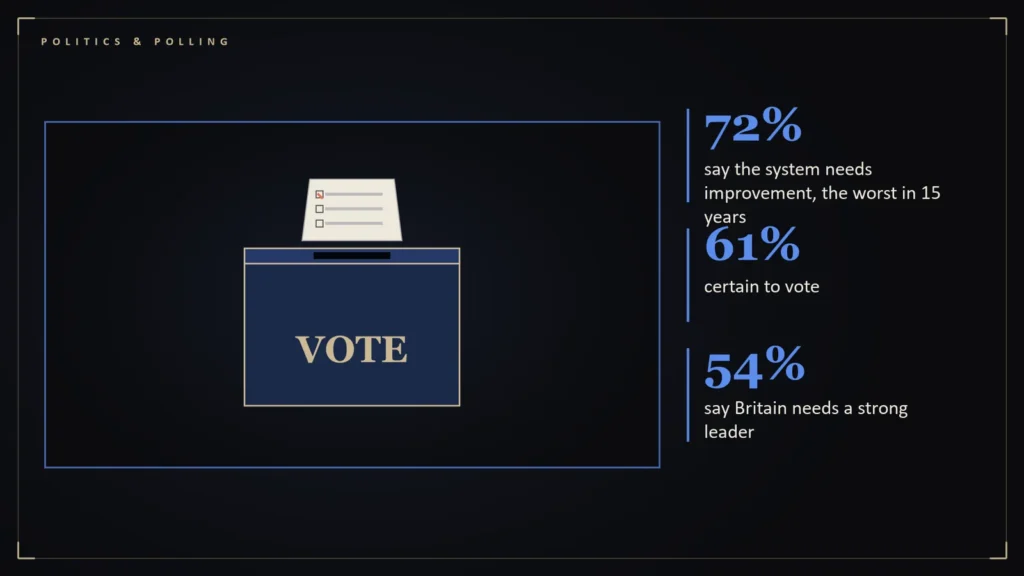
Hansard Society's 2019 Audit of Political Engagement found 61% certain to vote, but 72% wanted the system improved and 54% wanted a leader who breaks rules.
This piece is about a poll from 2019, and it is worth reading because it names a pattern that has outlived its year: participation can stay steady while trust quietly drains.
- The Hansard Society’s 16th Audit of Political Engagement, published April 8, 2019, found 54 percent say Britain needs a strong leader willing to break the rules [1].
- Seventy-two percent said the system of governing needs quite a lot or a great deal of improvement, the worst rating in 15 years [1].
- Yet 61 percent said they were certain to vote, and interest among 18-to-34-year-olds was at a 13-year high [1].
- Nearly half felt they had no influence over national decision-making, a 15-year high for powerlessness [1].
What the audit measured
The Hansard Society’s Audit of Political Engagement is described as the only annual health check on the state of Britain’s democracy. Its 16th edition, published on April 8, 2019 and conducted through face-to-face surveys with representative adult samples, was written up by director Ruth Fox and senior researcher Joel Blackwell [1].
The paradox
On the surface, engagement looked steady: 61 percent said they were certain to vote, and interest in politics among 18-to-34-year-olds had reached its highest point in 13 years [1]. Underneath, the audit found deeper disengagement. Seventy-two percent said the system of governing needed quite a lot or a great deal of improvement, the worst rating in 15 years, and nearly half of respondents said they had no influence over national decision-making, a 15-year high [1].
The strong-leader finding
The headline number was that 54 percent agreed Britain “needs a strong leader who is willing to break the rules” [1]. That figure sits uneasily next to the finding that people still intended to vote, and the combination is the paradox: wanting the democratic ritual to continue while doubting that it delivers.
How dissatisfied, and with what
The Hansard Society’s 16th audit, published April 8, 2019, supplies the detail behind the headline numbers. Confidence in MPs was 34 percent and in political parties 29 percent, against 74 percent for the military, 69 percent for judges and 49 percent for civil servants [1]. Fifty percent said the main parties do not care about people like them, 75 percent thought the main parties are too divided to serve the national interest, and 60 percent said the system is rigged to favor the rich and powerful [1]. Fifty-six percent believed Britain is in decline [1].
Yet the audit found both anger and appetite for compromise: 66 percent wanted politicians to speak freely whatever the opinion, 66 percent preferred politicians who compromise, and 47 percent preferred experienced leaders over radical change (43 percent) [1]. About 47 percent felt no influence over national decisions, a 15-year high, 30 percent never discuss politics with others and 53 percent took no online political action in the past year [1]. The audit is the sixteenth since 2004, and it is a 2019 survey, so it describes the mood of that time, not today’s [1].
How to use a dated poll
A 2019 survey cannot tell you what Britons think in 2026. It can show what a stressed democracy looks like in the data: stable turnout intentions, falling satisfaction, rising appetite for shortcuts. When you see a newer poll with the same pattern, you will know what to call it. For current numbers, consult the Society’s most recent audit.
Questions readers ask
What did the Hansard Society's 2019 audit find about democracy?
It found 54 percent wanted a leader willing to break the rules and 72 percent said the system needed improvement, while 61 percent were certain to vote [1].
References
- The Hansard Society research reveals public disengagement — PoliticsHome — https://www.politicshome.com/news/article/the-hansard-society-research-reveals-public-disengagement