Apollo-Soyuz, 1975: The Handshake in Space
Apollo-Soyuz launched July 15, 1975 and docked two days later when astronaut Tom Stafford shook hands with cosmonaut Aleksei Leonov. What the mission tested.
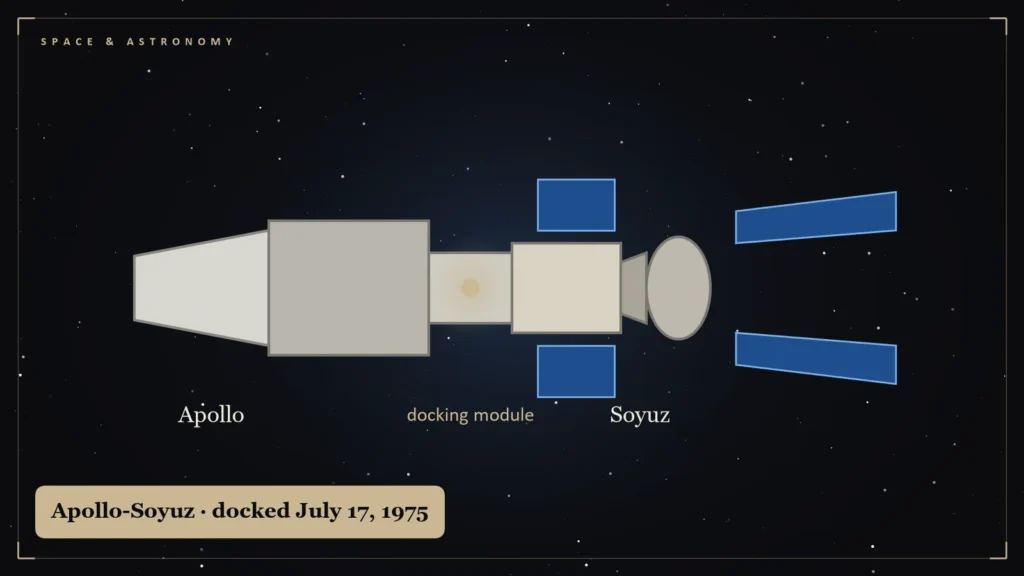
In 1975 two rivals shook hands in orbit. The Apollo-Soyuz Test Project was less about spectacle than plumbing: could a spacecraft from one country connect to a spacecraft from another? The answer was a handshake through a hatch.
- Apollo and Soyuz docked on July 17, 1975, two days after launch [1].
- The crews were Thomas Stafford, Vance Brand and Deke Slayton for Apollo, and Aleksei Leonov and Valeri Kubasov for Soyuz [1].
- A Docking Module served as an airlock between the spacecraft so crews could equalise pressure [1].
- Joint experiments included an artificial solar eclipse that let Leonov and Kubasov photograph the Sun’s corona [1].
The mission
NASA’s history office records that the two spacecraft launched two days before docking on July 17, 1975 [1]. The Soyuz crew was Aleksei Leonov and Valeri Kubasov. The Apollo crew was Thomas Stafford, Vance Brand and Donald “Deke” Slayton [1].
Contact
Stafford eased Apollo toward Soyuz and called out “Contact!” Leonov answered that Soyuz and Apollo were shaking hands [1]. When the hatches opened, Stafford and Leonov met at the interface and shook hands. Leonov said, “Very good to see you,” and Stafford replied in Russian that he was very happy, my friend [1].
An airlock in the middle
The two craft used different atmospheres, so NASA built a Docking Module that worked as an airlock. Crews could equalise pressure before moving between vehicles [1]. Think of it as a vestibule between two houses with different heating.
Science while docked
The crews stayed docked for about two days, working through July 19 [1]. In one experiment, they created an artificial solar eclipse so Leonov and Kubasov could photograph the Sun’s corona. A second experiment sent monochromatic light beams between the craft using retroreflectors to measure ultraviolet absorption [1].
What else the mission did
The agreement for the joint mission was signed in 1972, and the docked operations lasted about 47 hours [2]. The Smithsonian’s National Air and Space Museum notes that the flight gave American astronauts an opportunity to observe and photograph the Earth systematically from space; the Earth Observations and Photography Experiment produced approximately 2,000 pictures, about 750 of good quality (not cloud-obscured), with geologist Farouk El-Baz leading the preparation of the astronauts [2].
The museum displays the hardware in its docked configuration, including test Apollo command and service modules, backup flight hardware for the docking module and a full-scale Soyuz model [2]. It describes the mission as a joint effort between the two major world players that set a precedent for later cooperation such as the Shuttle-Mir Program and the International Space Station [2]. The handshake is the memorable image, but the lasting product was a docking standard that let spacecraft from different countries connect.
Why it mattered
The mission tested a universal docking system and showed that crews from two former competitors could work together [1]. The practical fruit of that principle is the international crews now working in orbit.
- Launch: July 15, 1975.
- Docking: July 17, 1975.
- Joint operations: through July 19.
Questions readers ask
When did Apollo and Soyuz dock?
On July 17, 1975, two days after launch, according to NASA’s history office [1].
Why was a docking module needed?
It worked as an airlock so crews could equalise pressure between the two spacecraft before moving between them [1].
References
- 45 Years Ago: Historic Handshake in Space, NASA History — https://www.nasa.gov/history/45-years-ago-historic-handshake-in-space/
- Apollo-Soyuz Test Project, Smithsonian National Air and Space Museum — https://airandspace.si.edu/stories/editorial/apollo-soyuz-test-project