Merch Is the New Album: Inside the $16 Billion Fandom Economy
MIDiA projects a $16.3 billion merch market by 2030, with growth slowing to 1.6% a year. atVenu shows how many concertgoers buy. What the numbers mean.
The album used to be the product and the shirt was the souvenir. Look at the numbers now and the roles have quietly swapped places: the record is the trailer, and the thing you carry out of the building is the feature.
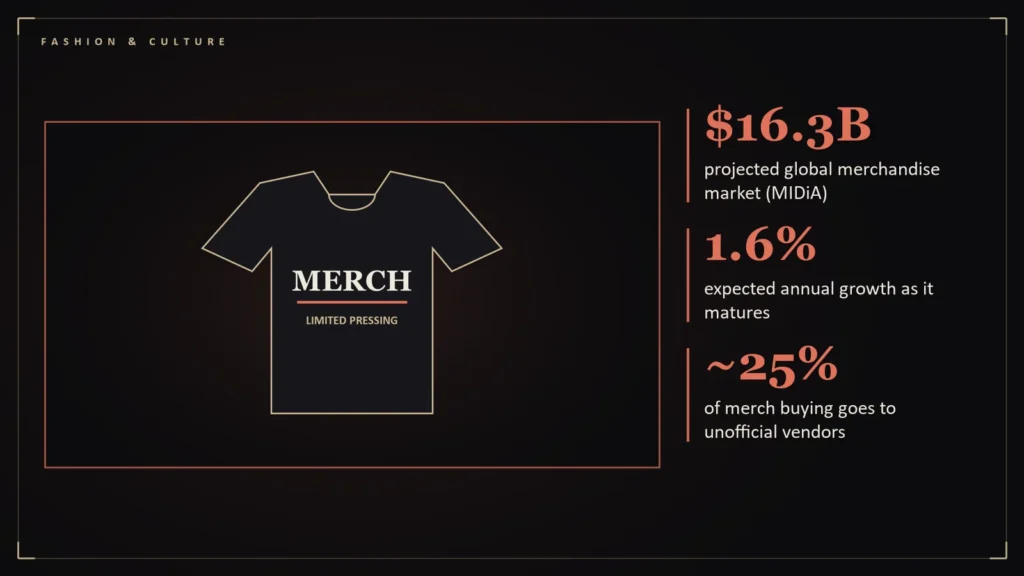
- MIDiA Research projects the global merchandise market, covering digital merch, physical merch and physical music, will reach $16.3 billion by 2030 [1].
- Growth is cooling: MIDiA expects annual revenue growth to fall to 1.6 percent as the market matures [1].
- About a quarter of merchandise purchasing goes to unofficial vendors, including fan-made and second-hand sellers [1].
- atVenu data shows the share of concert attendees buying merch rose from 11 percent in 2019 to 19 percent in 2021 and held at 19 percent in 2022, with $8.13 average spend per attendee [2].
The headline number, and the fine print
MIDiA Research projects that the combined merchandise market, which it defines to include digital merchandise, physical merchandise and physical music, will hit $16.3 billion by 2030 [1]. That is a big number with a cooling engine under it: MIDiA expects annual growth to slow to 1.6 percent as the market matures, and physical music revenue (vinyl, CDs and cassettes) to peak in 2026 [1]. The money is not vanishing, but the era of easy compounding is ending.
MIDiA’s sharper warning is about how the market grows from here. Its argument is that merchandise growth depends on cultivating engaged fan bases, not squeezing the maximum out of existing superfans, because over-monetizing a devoted audience can undermine the very fandom that pays [1].
How many fans actually buy
Venue-level data from atVenu, which analyzed more than 130,000 shows in 2022, shows how quickly the habit grew. The share of concert attendees buying merchandise nearly doubled, from 11 percent in 2019 to 19 percent in 2021, and it stayed at 19 percent in 2022 [2]. Average spend per attendee in 2022 was $8.13, down 4 percent from 2021 but up 46 percent from 2019; atVenu attributes the dip to a broader mix of artist sizes as venues returned to full capacity, not to waning interest [2].
What the venue data adds
The atVenu figures give a ground-level check on the big projection. Average merchandise spend per attendee in 2022 was $8.13, down 4 percent from 2021 but up 46 percent from 2019 [2]. The mix of shows also shifted: 17 percent of shows in 2019 averaged more than 5,000 attendees, 37 percent did in 2021 and 23 percent in 2022 [2]. Because larger shows tend to sell differently from small ones, a change in that mix can move the headline average without any change in fan behaviour, so it is worth reading the two numbers together.
The sample is large: atVenu said its 2022 analysis drew on more than 130,000 shows run through its system [2]. But the post is about participation rates, not product-level prices or aggregate revenue, and it did not break results out by genre or ticket tier [2]. That is a reminder that the $16.3 billion projection and the per-fan dollars are different kinds of numbers, built from different data, and should not be multiplied together.
The leak nobody can see
MIDiA also estimates that around a quarter of merch buying goes to unofficial sellers, a mixture of fan-made designs and second-hand markets, which means the official industry is already competing with its own audience’s creativity [1]. That is both a threat and a clue. Fans want the object badly enough to make it, resell it and hunt for it.
Put the pieces together and the picture is clear. Merch is where fandom turns into something you can hold, it is a large and mature market, and the winners will be the acts and shops that treat it as a relationship and not a toll booth.
Questions readers ask
How big is the music merchandise market?
MIDiA Research projects the global merchandise market, including digital merch, physical merch and physical music, will reach $16.3 billion by 2030 [1].
How many concertgoers buy merchandise?
atVenu’s analysis found 19 percent of attendees bought merch in 2021 and in 2022, up from 11 percent in 2019 [2].
References
- How Big Can Music Merch Get? MIDiA's Latest Report Charts the Course to $16B by 2030 — MIDiA Research — https://www.midiaresearch.com/blog/how-big-can-music-merch-get-midias-latest-report-charts-the-course-to-16b-by-2030
- The New Normal for Fan Interest in Concert Merchandise — atVenu — https://www.atvenu.com/post/the-new-normal-for-concert-merchandise