Edison’s Tinfoil Phonograph: The First Machine That Remembered a Voice
In 1877 Edison's phonograph etched a voice into tinfoil, and the foil tore after a few plays. How the first sound recorder worked and why it still matters.
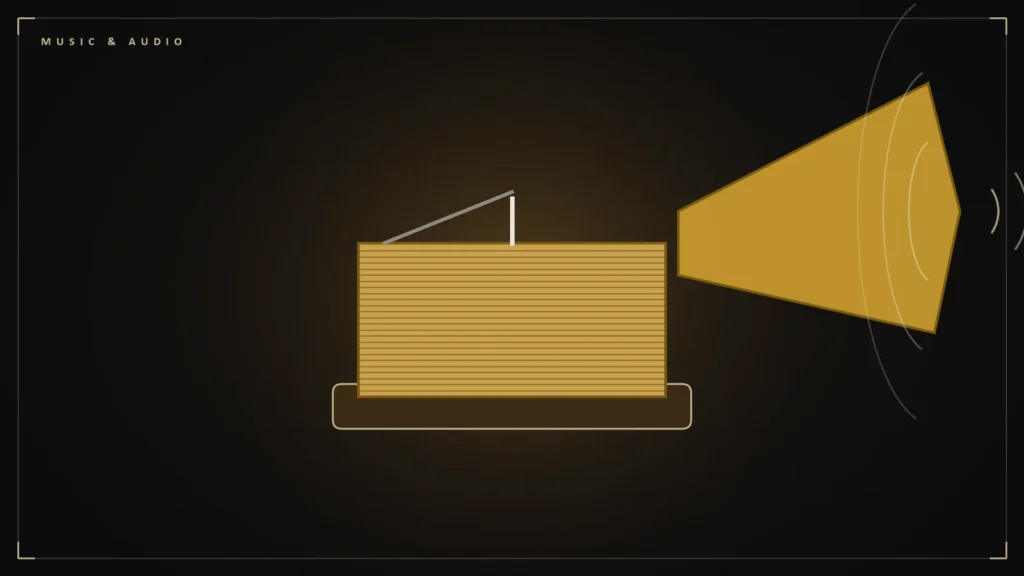
Before 1877, a spoken sentence vanished the moment it left the speaker’s mouth. Thomas Edison’s phonograph changed that, and the first version was as fragile as a soap bubble: it could capture a voice, but not keep it for long.
- Edison invented the phonograph in 1877 at his Menlo Park laboratory [1].
- A needle cut a groove in tinfoil wrapped on a cylinder as a person spoke and turned a handle; a second needle replayed it [1].
- After just a few plays the tinfoil would tear and the message could no longer be played [1].
- Over fifty years Edison improved the phonograph, moving from tinfoil to cylinder records and then to discs [1].
How the machine worked
The phonograph was invented in 1877 at Edison’s Menlo Park laboratory in New Jersey [1]. A thin metal sheet, tinfoil, was wrapped around a cylinder. A person spoke into a mouthpiece while turning a handle. Sound made a needle vibrate, and the needle pressed a groove into the foil. To play the message back, a second needle followed the groove [1].
A recording that wore out
The materials were the weak point. The National Park Service, which keeps Edison’s laboratory as a historic site, notes that “after just a few plays, the tin-foil would tear up and the message could no longer be played” [1]. Think of a footprint in wet sand: the shape records the passage, but each touch erodes it.
Fifty years of improvement
Edison did not abandon the idea. According to the Park Service, he improved the phonograph repeatedly over fifty years, moving from tinfoil to records in cylinder shape and then to disc-shaped records similar to CDs [1]. The same principle, a groove carrying a pattern of vibration, survives in the vinyl record.
An inventor who could barely hear it
The Park Service adds a human detail: Edison regarded the phonograph as his “baby,” reportedly his favorite invention, despite his own profound hearing loss [1]. The man who gave the world recorded sound heard it imperfectly himself.
The first test, and what happened to the originals
The Engineering and Technology History Wiki gives the paper trail. Edison drew sketches on November 29, 1877, filed a patent on December 15, 1877, and the public announcement appeared in Scientific American on December 22, 1877 [2]. He intended the phonograph primarily as a telephone recorder for business use, much as the telephone itself was used [2]. The first cylinder machine embossed the sound record in a groove on a thick sheet of tinfoil, and in December 1877 Edison recorded himself reciting “Mary had a little lamb” and played back a highly distorted but recognizable version [2].
Few of those early recordings survive. Most of the original 1877 and 1878 tinfoil recordings are lost, and a few are preserved at the Edison National Historic Site in New Jersey but have never been played [2]. Edison later introduced greatly improved wax cylinders, and the earliest existing cylinder recordings date from almost ten years after the first test, around 1887 [2]. That gap, ten years from a faint tinfoil recording to a durable one, is a good measure of how long it took to turn a demonstration into a medium.
What carries forward
- The idea of storage. Sound could finally be kept and replayed.
- The race for durability. Each later format, from cylinder to disc to digital file, solved the problem of wear.
- Quality as an engineering target. Today’s lossless audio is a descendant of the same ambition: keep the sound intact.
Questions readers ask
When was the phonograph invented?
Thomas Edison invented it in 1877 at his Menlo Park laboratory, according to the National Park Service [1].
Why did the first phonograph recordings not last?
They were made on tinfoil, which would tear after just a few plays [1].
References
- The Phonograph, Edison National Historical Park, National Park Service — https://www.nps.gov/edis/learn/kidsyouth/the-phonograph.htm
- Phonograph, Engineering and Technology History Wiki — https://ethw.org/Phonograph