Why 44.1 kHz Is Enough: The Sampling Theorem in Plain Words
The sampling theorem says a signal below half the sampling rate is captured perfectly. At 44.1 kHz that reaches 22.05 kHz, past human hearing.
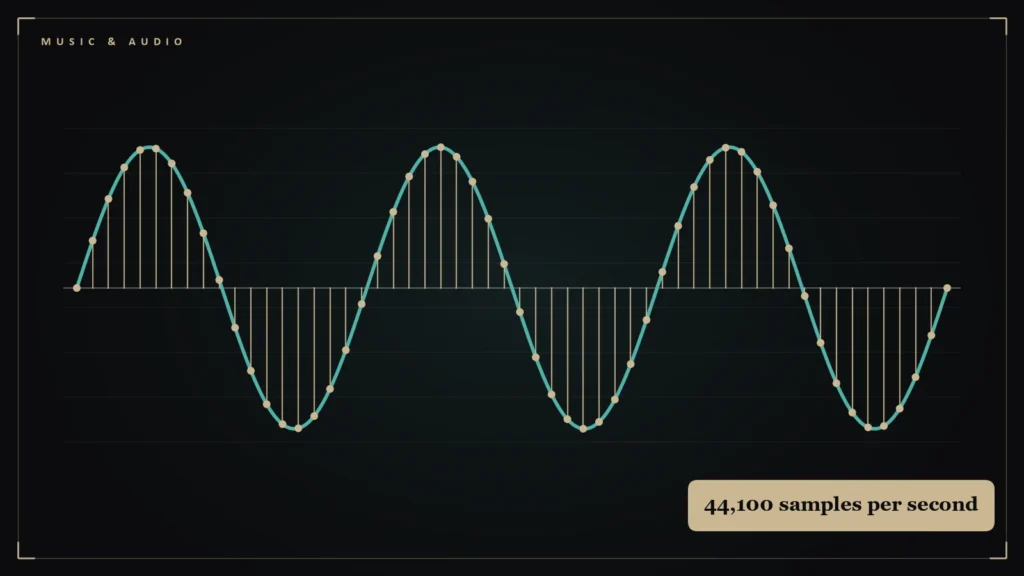
Digital audio sounds like it should lose something. It chops a smooth wave into numbers, after all. The sampling theorem is the reason the chopping does not matter, and it is easier to grasp with a picture than with equations: imagine a rope shaken by hand, photographed often enough that no wiggle can hide between two photos.
- All signals with content entirely below the Nyquist frequency, half the sampling rate, are captured perfectly and completely by sampling [1].
- At 44.1 kHz the Nyquist frequency is 22.05 kHz, above the limit of human hearing [1].
- With proper dithering, 16-bit audio reaches an effective dynamic range of about 120 dB in practice [1].
- A 24-bit/192 kHz file takes six times the space of 16-bit/44.1 kHz [1].
What the theorem promises
Monty Montgomery of Xiph.Org, the group behind the Ogg Vorbis and FLAC formats, explains it this way: all signals with content entirely below the Nyquist frequency, which is half the sampling rate, are captured perfectly and completely by sampling [1]. The key word is perfectly. Between the sample points, nothing is missing, as long as the signal stays below that limit.
The arithmetic for CDs
CD audio samples 44,100 times a second. Half of that is 22,050 hertz, or 22.05 kHz [1]. Human hearing is commonly described as running from about 20 Hz to 20 kHz. Xiph calls that a generous range that thoroughly covers the audible spectrum, backed by nearly a century of experimental data [1]. The CD’s ceiling sits just above it.
And the volume side?
Bit depth sets the gap between the quietest and loudest sound. With proper dithering, a technique that adds a tiny amount of noise to avoid distortion, the effective dynamic range of 16-bit audio reaches 120 dB in practice [1]. The article compares this to the difference between a mosquito somewhere in the same room and a jackhammer a foot away [1].
Why more is not always better
Xiph argues that going far beyond the audible range can backfire. If playback gear is not perfectly linear, ultrasonic content can fold down into the audible range as distortion [1]. A 24-bit/192 kHz file also takes six times the space of a 16-bit/44.1 kHz one [1]. The article cites a Boston Audio Society study in which listeners chose correctly 49.8 percent of the time, essentially guessing [1].
How to hold this in your head
- The theorem is math, not opinion. It explains why CD-rate audio captures everything audible.
- Higher resolution has uses. Xiph itself notes reasons to use more bits during recording and production [1].
- It is one side of a debate. The Xiph article is an argument, and some people disagree with it. See our guide to what lossless audio means.
Questions readers ask
What is the Nyquist frequency?
It is half the sampling rate; signals entirely below it are captured perfectly by sampling, which for 44.1 kHz audio means up to 22.05 kHz [1].
How much dynamic range does 16-bit audio have?
With proper dithering, the effective dynamic range of 16-bit audio reaches about 120 dB in practice, according to Xiph.Org [1].
References
- 24/192 Music Downloads Are Very Silly Indeed, Xiph.Org — https://people.xiph.org/~xiphmont/demo/neil-young.html