FLAC vs MP3: Can You Actually Hear the Difference?
In NPR's blind listening quiz, people barely beat chance at picking lossless over MP3. So why bother with FLAC? Because of what it lets you keep.
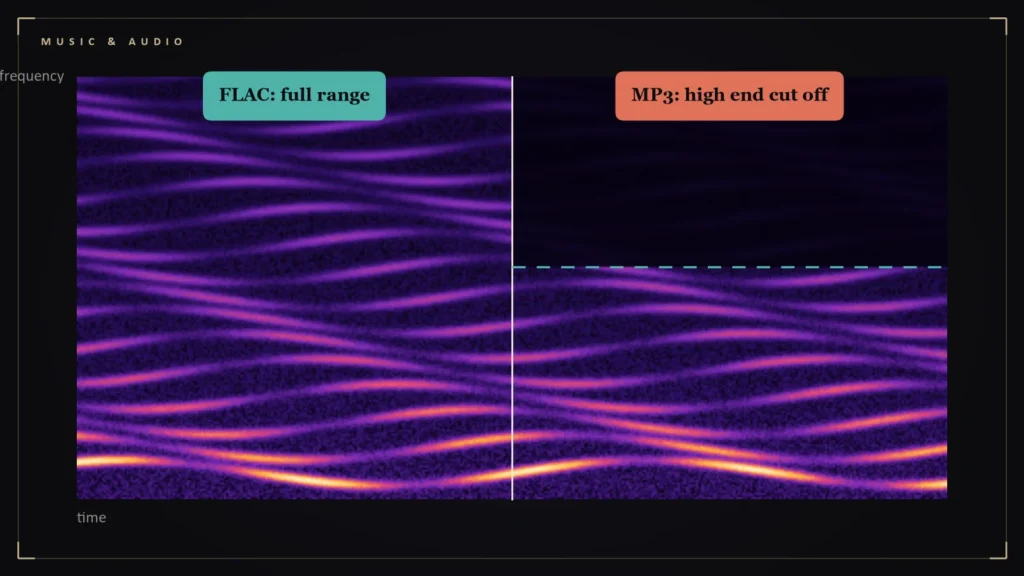
Here is the awkward truth in the FLAC-versus-MP3 argument: most people, in a blind test, cannot do it. When NPR ran an online listening quiz in 2015 with a lossless WAV, a 320 kbps MP3 and a 128 kbps MP3, listeners picked the lossless file 36.0 percent of the time. Chance alone would have produced 33.3 percent [2]. If you came here to hear a magic difference, you may be disappointed. If you came to learn what you are actually buying, keep reading.
- MP3 is lossy and permanently discards audio data; FLAC is lossless, so the audio you decode is the audio that went in [1].
- In NPR’s 2015 online listening quiz, lossless was picked 36.0 percent of the time against 33.3 percent expected by pure chance [2].
- At 320 kbps, MP3 is close enough that many listeners cannot reliably tell it from lossless; the case for FLAC is mainly longevity and flexibility.
- Re-encoding a lossy file degrades it again, so keep a lossless master and make MP3s from it, never the other way round.
What the two formats do
MP3 is a lossy format. It listens, in a mathematical sense, for sounds it predicts you will not miss and throws them away permanently, which is how a track shrinks from tens of megabytes to a few. FLAC compresses without discarding anything, so what you decode is what went in [1]. The difference is not that one is smaller and one is bigger. It is that one made a decision for you, forever, and the other did not. For the wider picture see what lossless audio is.
Why the quiz result is less damning than it looks
A 320 kbps MP3 is a generous encoding. It leaves little to hear on laptop speakers or earbuds on a train, and an online quiz runs on whatever equipment each listener happens to own. Dramatic differences show up at the other end: a 128 kbps file on decent headphones, where cymbals smear and reverb tails turn grainy. Treat any claim that lossless is audibly obvious on all gear with the same suspicion as any claim that it makes no difference at all. Your ears, your headphones and your music decide.
The real argument for FLAC is time
Lossy encoding is a one-way door. Edit an MP3 and export it again, and you have compressed already-compressed audio; each pass throws away a little more. A lossless file has no such tax. That makes FLAC the right master copy: from it you can export an MP3 for the gym, an AAC for the phone and a smaller file for a USB stick, whenever you like. From an MP3 you can only ever make worse copies of a worse copy.
When MP3 is the sensible choice
- Podcasts, audiobooks and talk radio, where there is little fine detail to lose.
- An old phone or a tight storage budget.
- Noisy places, like a gym or a commute, that mask subtle detail anyway.
Everything else, from the albums you will still love in ten years to anything you might want to remaster, deserves a lossless master. That is why every Godlike release comes as lossless WAV and hi-res FLAC downloads: you own the master, and the MP3s are yours to make. Hear the whole discography and decide with your own ears.
Questions readers ask
Is FLAC really better than 320 kbps MP3?
Technically yes, since FLAC keeps all the audio data and MP3 discards some. Whether you can hear it depends on your gear and the track; in NPR’s quiz, listeners chose lossless only slightly more often than chance [1][2].
Can I convert FLAC to MP3?
Yes, and that is the right direction. Keep the FLAC as your master and export MP3s for devices that need small files.
Does FLAC take more storage?
Yes. It is larger than any MP3 of the same track, although how much depends on the music and the MP3 bitrate.
References
- FLAC FAQ — Xiph.Org Foundation — https://xiph.org/flac/faq.html
- Audio Quality Quiz Results: You Did Slightly Better Than Guessing Randomly — NPR — https://www.npr.org/sections/therecord/2015/06/09/412271433/audio-quality-quiz-results-y