The Cosmic Microwave Background: A Hiss Found by Accident in 1965
In 1965 two Bell Labs engineers chased noise in a horn antenna and found the oldest light in the universe, later measured at 2.73 kelvin.
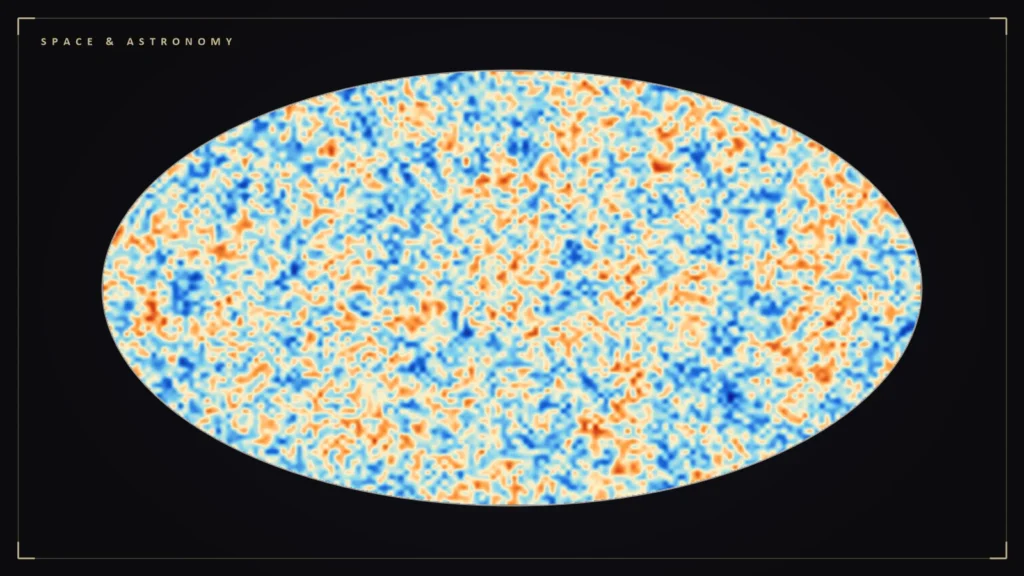
The most important radio static in physics was first treated as a nuisance. Two engineers at Bell Labs spent months trying to get rid of a hiss in their antenna, and the hiss turned out to be the afterglow of the universe itself.
- Arno Penzias and Robert Wilson of Bell Telephone Laboratories found the radiation in 1965 using a 20-foot horn antenna at Holmdel, New Jersey [1].
- After removing atmospheric and equipment noise they were left with radiation equivalent to 3.5 kelvin coming from empty space [1].
- Robert Dicke’s team at Princeton was preparing to look for the same signal, and the groups announced their results together [1].
- Later measurements put the temperature at about 2.73 kelvin, varying by about one part in 100,000 [2].
An antenna built for a satellite
NASA’s Cosmic Times archive describes the instrument: a 20-foot horn antenna at Holmdel, New Jersey, originally built to test communications with NASA’s Echo satellite [1]. Arno Penzias and Robert Wilson found it picked up an unexplained microwave signal. After subtracting radiation from Earth’s atmosphere and from the antenna itself, they were still left with radiation matching a temperature of 3.5 kelvin coming from empty space [1].
Princeton was looking for the same thing
Meanwhile, Robert Dicke’s team at Princeton University was independently building a telescope to look for just this kind of radiation. When the two groups learned of each other’s work, they announced the discovery together in the Astrophysical Journal [1]. Dicke’s team explained that thermal radiation left over from a hot early universe is expected if one traces the expansion back to a time when the temperature was of the order of 10 billion kelvin [1].
The oldest light
The radiation is a relic of the early universe. The Cosmic Times page calls the discovery the first observational evidence that the universe began with a Big Bang, supporting predictions made decades earlier by Gamow, Alpher and Herman [1].
Measured ever more finely
The European Space Agency’s history notes that NASA’s COBE satellite confirmed in 1992 that the temperature was not identical over the whole sky, WMAP sharpened the map in 2003, and ESA’s Planck mission came next [2]. The temperature varies by about one part in 100,000 around an average of 2.73 kelvin [2]. Those tiny ripples are the seeds of galaxies, like a faint pattern in frost that shows where the ice will thicken.
What 2.73 kelvin means in light
A blackbody at 2.73 kelvin radiates most strongly at a wavelength of about 1.06 millimeters, according to Wien’s displacement law (peak wavelength equals 2.898 millimeter-kelvins divided by the temperature; my calculation), which falls in the microwave band, hence the name [2]. That is why the discovery came from a microwave horn antenna and not an optical telescope. The tiny variations of about one part in 100,000 correspond to temperature differences of roughly 27 millionths of a kelvin around the average [2] (my arithmetic).
Why it makes a good story
- Serendipity needs preparation. The engineers carefully subtracted every known source of noise before trusting the leftover.
- Two groups, one answer. Theory and measurement met in one journal issue.
- Precision grew. From a rough 3.5 kelvin to ripples of one part in 100,000.
Questions readers ask
Who discovered the cosmic microwave background?
Arno Penzias and Robert Wilson of Bell Telephone Laboratories found it in 1965 with a horn antenna at Holmdel, New Jersey [1].
What is the temperature of the cosmic microwave background?
About 2.73 kelvin, varying by about one part in 100,000 across the sky, according to ESA [2].
References
- Murmur of a Bang, Cosmic Times 1965, NASA — https://imagine.gsfc.nasa.gov/educators/programs/cosmictimes/online_edition/1965/murmur.html
- History of microwave astronomy, European Space Agency — https://www.esa.int/Science_Exploration/Space_Science/Planck/History_of_microwave_astronomy