From Stage Prop to Souvenir Mug: How Theater Learned to Sell the Show
Props entered English in 1425. Broadway's first poster shop opened in 1965, and Cats made a logo shirt a bestseller. A short history of theater merch.
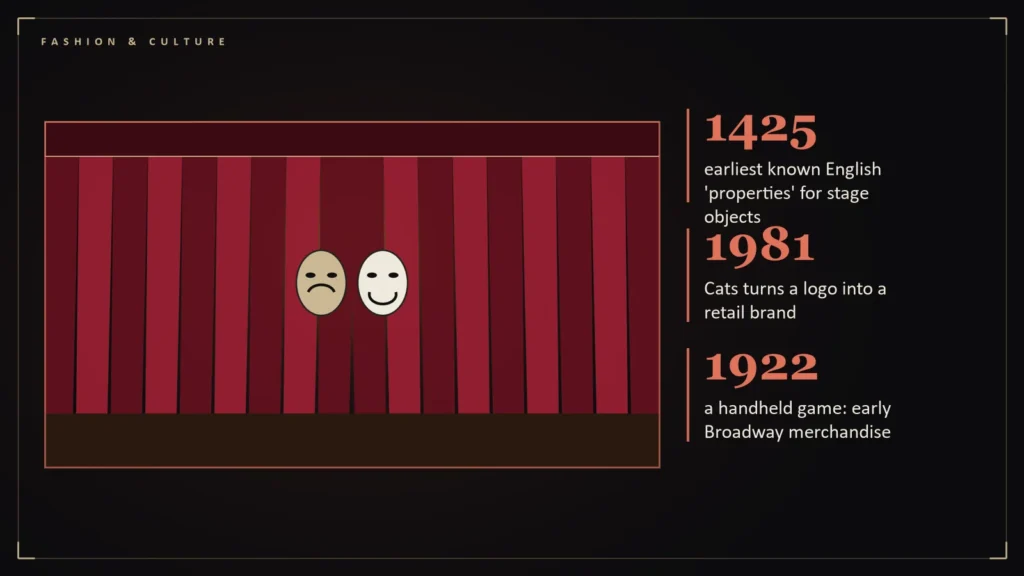
The first stage “property” on record was not a sword or a skull. It was a word, written into a 1425 morality play called The Castle of Perseverance, the earliest known English use of the term for objects an actor handles on stage [1]. Six centuries later, the same category of object is sold in lobby kiosks as keychains, and a few of its movie cousins sell for the price of a house. This is how the trip happened.
- The earliest known English use of “properties” for stage objects is in a 1425 morality play, The Castle of Perseverance [1].
- Broadway merchandise runs on a short, traceable timeline: a handheld game in 1922, licensed South Pacific goods in the 1940s, the first theater poster shop in 1965, and a shop at One Shubert Alley in 1979 [2][3].
- Cats (1981) turned a logo into a retail brand; its shirt ranked second only to Hard Rock Cafe’s among the decade’s best-selling T-shirts [2].
- Film props now reach seven figures at auction, with Darth Vader’s lightsaber fetching $3.654 million in September 2025 [4].
The souvenir was an accident before it was a business
Theater did not start selling merchandise so much as stumble into it. In 1922 the Broadway revue Shuffle Along handed out a handheld game for its first anniversary [2]. In the 1940s, the producers of South Pacific discovered that people were selling counterfeit ticket stubs, and answered by licensing the real thing: dolls, linens, mirrors, and cigarette cases [2]. Piracy taught the industry that audiences wanted to take something home, and would pay.
The retail shelf itself arrived later. In October 1965 the Triton Gallery on West 44th Street became Broadway’s first theater poster shop. Its founder, Roger Plunkett, recalled the moment it clicked: “customers came in wanting to buy the posters, with or without the frames” [3]. In July 1979 a small shop in the Booth Theatre’s backstage space opened as One Shubert Alley and began selling T-shirts, tote bags, mugs, and posters [3].
Cats put a logo on everything
Through the early 1970s, producers copied rock-concert merchandising with lobby booths and hand-stapled T-shirts [2]. Then came Cameron Mackintosh and Cats in 1981. The show’s glowing yellow eyes were printed on shirts, toys, and watches, and the logo shirt ranked as the second most popular T-shirt of the 1980s, behind only Hard Rock Cafe’s [2]. A musical stopped being just a night out and became a brand you could wear to the grocery store.
The formula has barely changed. TheaterMania lists ten standard products: programs, logo T-shirts, sweatshirts, magnets, coffee mugs, window posters, keychains, tote bags, lapel pins, and phone accessories [2]. What shifted is taste. Peter Milano of Creative Goods says merchandise has “evolved so much” since 2008, moving from plain logo items toward fashion and bespoke opening-night gifts: charm bracelets for Dear Evan Hansen, North Face vests for The Elephant Man, custom skateboards for West Side Story [3]. Six went further and gave each of its queens a product line of her own [2].
Why a lightsaber costs more than a theater
Movie props occupy a different universe. A stage prop is rebuilt every time it breaks and used up every night; a film prop that appeared on screen can be one irreplaceable object. On September 4, 2025, Propstore sold Darth Vader’s lightsaber from The Empire Strikes Back and Return of the Jedi for $3.654 million, against a pre-sale estimate of $1 million to $3 million, after 31 bids [4]. A light-up C-3PO head worn by Anthony Daniels in Empire sold for $1,058,400 in March 2024, topping the $843,051 paid for a C-3PO head from the first film in 2023 [5].
Think of it as the difference between the Mona Lisa and the postcard of the Mona Lisa. The lightsaber is the original, priced by scarcity. The keychain is the postcard, priced by volume. Both exist because someone believed an object could carry a feeling out of a dark room, and the fans proved them right.
What the merch table is really selling
A theater’s merchandise stand is the only place the show can leave the building. That is why the best items, a sharp poster or a well-made tee, hold their value in a way a generic mug cannot: they are evidence you were there. The same logic is why collectors chase rare band shirts and limited posters, and it is what separates a souvenir from a keepsake. The souvenir says “I visited.” The keepsake says “this happened to me.”
Questions readers ask
When did the word “props” first appear in English?
The earliest known English use of “properties” for stage objects is in the 1425 morality play The Castle of Perseverance [1].
What was Broadway's first merchandise shop?
The Triton Gallery on West 44th Street opened in October 1965 as the first theater poster shop, and One Shubert Alley followed in July 1979 [3].
What is the most expensive Star Wars prop ever sold at auction?
Darth Vader’s lightsaber, sold by Propstore in September 2025 for $3.654 million [4].
References
- First use of “Property” in the theatrical sense — Eric Hart, Props — https://www.props.eric-hart.com/?p=730
- Memorializing the Moment: A History of Musical Theater Merchandise — TheaterMania — https://www.theatermania.com/news/memorializing-the-moment-a-history-of-musical-theater-merchandise_92153
- Theatre Swag! Believe It or Not, Those Mugs, Keychains and T-Shirts Have a History — Encore Magazine — https://encoremagazine.com/theatre-swag-believe-it-or-not-those-mugs-keychains-and-t-shirts-have-a-history
- Darth Vader lightsaber sold at auction — Global News — https://globalnews.ca/news/11395300/darth-vader-lightsaber-sold-auction/amp/
- This C-3PO Head From The Empire Strikes Back Just Sold for More Than $1 Million at Auction — Smithsonian Magazine — https://www.smithsonianmag.com/smart-news/this-c-3po-head-from-the-empire-strikes-back-just-sold-for-more-than-1-million-at-auction-180988460/