Why a Zodiac Tee Says More Than a Name Tag
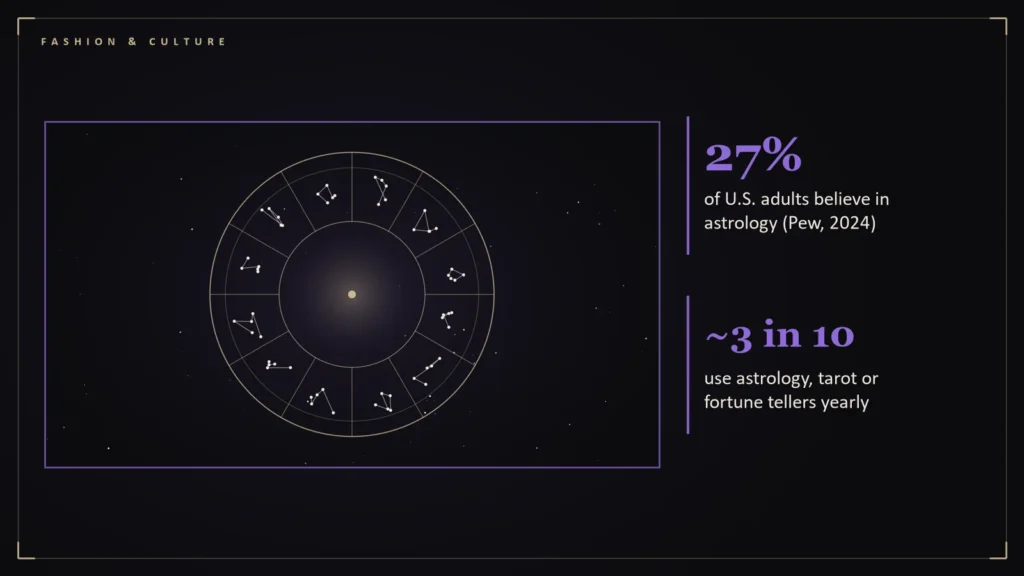
Pew finds 27% of U.S. adults believe in astrology and about 3 in 10 consult it yearly. That is why a zodiac print works as shorthand for who you are.
Ask a stranger their sign and you learn two things at once: when they were born, and how they would like to be read. A zodiac tee compresses that whole exchange into a single glance, which is the reason it keeps selling long after every other novelty print has gone out of style.
- Pew’s October 2024 survey of 9,593 U.S. adults found 27 percent believe in astrology, close to the 29 percent measured in 2017 [1].
- About 3 in 10 adults use astrology, tarot or fortune tellers at least once a year; about 2 in 10 mostly for fun and about 1 in 10 because they think it gives useful insight [1].
- A sign works on clothing the way a band logo does: it is a compact, shareable way to say what you are like.
- Only about 1 percent of adults say they rely heavily on these practices for major life decisions, so most wearers are playing, not praying [1].
A sign is a sentence you can wear
Think about what a band shirt does. It tells the room what you listen to, who you stood next to at the show, and which arguments you are prepared to have. A zodiac graphic does the same job with a narrower vocabulary. “Scorpio” is a one-word personality profile that everyone already knows how to decode, whether or not they believe in it. The garment hands people a ready-made opening line.
The audience is bigger than the skeptics assume
It is easy to treat astrology as a fringe habit. The numbers say otherwise. Pew Research Center interviewed 9,593 U.S. adults in October 2024 and found that 27 percent believe in astrology, a figure similar to the 29 percent it recorded in 2017 [1]. Beyond belief, about three in ten adults consult astrology, tarot cards or a fortune teller at least once a year [1]. That is a sizeable share of any shopping crowd.
A market behind the shirts
The audience for celestial clothing is also an industry audience. The same news report notes that the psychic services industry generated $2.3 billion in revenue in 2024 and employed 105,000 people, with revenue rising more than 4 percent a year since the start of the pandemic [1]. It quotes a view that traditional skepticism about consulting psychics has waned, with more consumers embracing these services, especially in times of uncertainty [1].
Belief is not spread evenly. About 3 in 10 Black Protestants, Hispanic Catholics and people with no particular religion believe in astrology, while atheists, agnostics, white evangelical Protestants and Jewish Americans showed lower rates [1]. Adults 65 and older, people with high incomes or college degrees, and political conservatives are also less likely to believe [1]. For a shop or a designer, the useful reading is that a zodiac print will land with some buyers as identity, with others as a joke and with some not at all, so a design that works as a graphic first and a sign second reaches the widest crowd.
Fun, not faith
The detail that matters most for anyone designing or buying this clothing is the motive. Of the three in ten who engage with these practices, about two in ten do it mostly for fun, and about one in ten because they believe it provides helpful insight. Only 1 percent say they rely heavily on them for major life decisions [1]. In other words, the person in the Aquarius hoodie is usually winking, not making financial plans around Saturn.
That tone is worth respecting. Zodiac clothing works best when it is playful about itself: a clever glyph, a constellation drawn with a steady hand, a color that fits the sign’s reputation. It stumbles when it tries to sound like a prophecy. Browse the Godlike lookbook for how celestial motifs sit alongside the rest of the collection.
Questions readers ask
How many Americans believe in astrology?
Pew Research Center’s October 2024 survey found 27 percent of U.S. adults believe in it, similar to 29 percent in 2017 [1].
Do people take astrology seriously?
Most do not rely on it heavily: about 2 in 10 adults engage mostly for fun, about 1 in 10 because they believe it gives insight, and about 1 percent use it for major decisions [1].
References
- How many Americans believe in astrology and rely on fortunetelling? — NBC Chicago, reporting Pew Research Center — https://www.nbcchicago.com/news/national-international/how-many-americans-believe-in-astrology-rely-on-fortunetelling/3751055/