How to Spot a Fake Vintage Band Tee Before You Pay for It
Check the hem, the tag, the ink and the fit, and never trust a printed date alone. A field guide to authenticating vintage concert T-shirts.
A counterfeit vintage tee is a forgery in a very good disguise: a modern blank, a faded 1989 tour print, a seller who knows exactly how long you have been looking for that band. The trick is that every individual clue can be faked. The shirt gives itself away when the clues disagree with each other.
- Cross-check the hem, the tag and the print. A copyright line only sets the earliest year a shirt could have been printed [1].
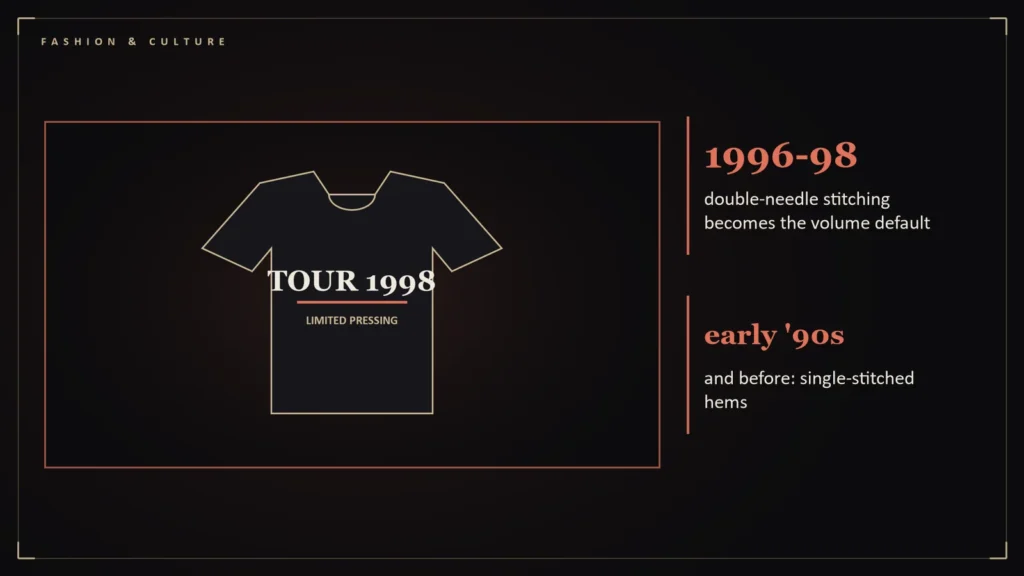
- Single-stitched hems point to the early ’90s or before; double-needle stitching became the volume default by roughly 1996 to 1998 [1][2].
- Real ’80s prints have ink you can feel, ’80s cotton is thin, and the tags are sewn into the neckline rather than heat-pressed [2].
- An era-correct bootleg is its own recognized vintage category, so “unlicensed” does not mean “fake” [1].
- Community checking exists: the Legiteem8 app offers a free crowd-sourced tier plus paid expert authentication [3].
Make the clues argue with each other
Think of authentication as cross-examination. A tag that belongs to the wrong era for the graphic it is attached to is, in one dealer’s words, a “near-instant disqualifier” [1]. And the date printed under the artwork is the weakest witness of all: the copyright year is only the earliest the graphic could have been produced. A “1992” line means the shirt was printed in 1992 or later, never earlier, and “later” can be thirty years later [1].
Read the shirt like a geologist reads rock
- The hem. Keep It Classic calls it the strongest era signal a tee carries [1]. Single-stitched hems and sleeves are typical of the early ’90s and before, with exceptions [2]. Two-needle stitching became the volume default somewhere between 1996 and 1998 for most lines [1].
- The tag. Genuine ’80s and ’90s shirts carry tags sewn into the neckline, not heat-pressed labels [2].
- The ink. Original ’80s prints are screen-printed ink you can feel on the surface. Gene Melkisethian of the Washington, D.C. shop Joint Custody puts it simply: “Cracked ink is common on those” [2].
- The weight and fit. ’80s shirts are noticeably thin, ’90s shirts thicker, and reprints from the 2000s onward feel excessively soft. Sizing drifts too: an ’80s large fits like a ’90s medium, so measure across the chest and from collar to hem instead of trusting the label [2].
- The wear. Pit stains and honest fading fit a shirt that was worn. Dry rot, a slight sheen and a caramel-like smell, means the fabric is dying [2].
“Bootleg” is not a synonym for “fake”
Parking-lot merch from the ’80s and ’90s, sold outside venues without the band’s blessing, is a recognized vintage category in its own right [1]. What you are checking is when a shirt was made. Whether the band got paid is a different question, and a rare one to be able to answer.
When your eyes are not enough
Vintage tees are a market without the authentication infrastructure that sneakers have, which is the gap Legiteem8 set out to fill [3]. The app was co-founded by James Applegath of Defunkd and Amir Vejdani of Citees. Its free tier works a bit like Wikipedia for shirts: contributors who prove accurate earn trusted-source status, and paid tiers bring in certified specialists with decades of combined experience [3]. When ThriftCon covered the launch, roughly 1,000 active users had authenticated hundreds of shirts [3]. For anything with four figures attached, pay the expert before you pay the seller.
One rule outranks the rest, and Melkisethian says it plainly: buy shirts you want [2]. A flawless shirt you will never wear is an expensive rag. A correct-enough tee you love is a good day.
Questions readers ask
Can a bootleg band shirt still be authentic vintage?
Yes. Era-correct unlicensed bootlegs, such as 1980s and 1990s parking-lot tour merch, are a recognized vintage category [1].
What should I check first on a vintage band tee?
Start with the hem and the tag, then the print, and see whether they agree on an era. A mismatch is the warning sign [1][2].
Does the copyright date tell me when the shirt was made?
No. It marks the earliest year the graphic could have been produced, so the shirt may be much newer [1].
References
- Vintage Tee Authentication Guide — Keep It Classic — https://keepitclassiclv.com/pages/vintage-tee-authentication-guide
- Vintage Band Tee or Fake? Joint Custody Shares 9 Tips to Spot the Real Thing — DC Fray — https://districtfray.com/articles/vintage-band-tees-joint-custody
- There's a Free, Easy Way to Authenticate Vintage T-Shirts Online — ThriftCon — https://thriftcon.co/blogs/how-to/theres-now-a-free-easy-way-to-authenticate-vintage-t-shirts-online