The Perseids Begin: Dust From a Comet That Last Visited in 1992
The Perseid meteor shower runs from July 14 to September 1, with 50 to 100 meteors an hour at the August peak, all from the debris of comet Swift-Tuttle.
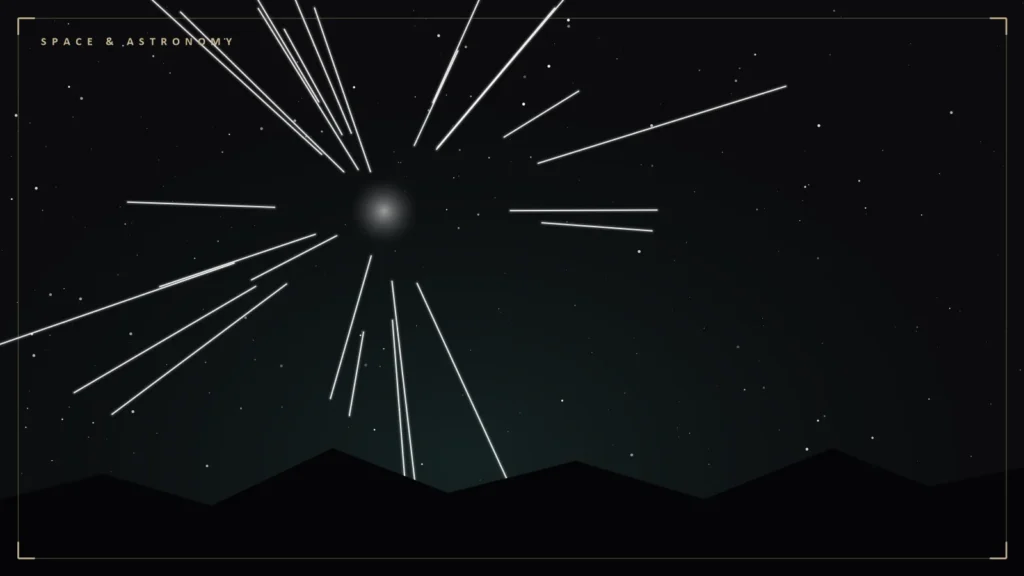
Each summer Earth drives through a river of dust. The river is the trail left by a comet, and when grains of it hit the atmosphere, they burn as shooting stars. The Perseids begin their run today, in the middle of July.
- The Perseids come from comet 109P/Swift-Tuttle, discovered in 1862 by Lewis Swift and Horace Tuttle [1].
- The shower runs from July 14 to September 1 and peaks in mid-August with about 50 to 100 meteors an hour [1].
- Perseid meteors travel at about 37 miles (59 km) per second [1].
- The comet takes 133 years to orbit the Sun; its last visit to the inner solar system was in 1992 [1].
Where the dust comes from
NASA says meteors come from leftover comet particles and bits of broken asteroids, and that when comets come around the Sun, they leave a dusty trail behind them [1]. The Perseids’ parent is comet 109P/Swift-Tuttle, discovered in 1862 by Lewis Swift and Horace Tuttle [1].
The calendar
The shower is active from July 14 to September 1, building to a peak in mid-August. At the peak, NASA says, about 50 to 100 meteors an hour may be seen [1]. Early in the run the numbers are small; the show grows like a crowd arriving for a concert.
Speed and brightness
Perseid meteors hit the atmosphere at 37 miles (59 kilometers) per second [1]. At that speed even a tiny grain glows. The Perseids are also known for fireballs, which NASA describes as larger explosions caused by bigger particles that shine brighter than the typical streak [1].
The slow clock behind a fast show
Swift-Tuttle takes 133 years to orbit the Sun once, and its last pass through the inner solar system was in 1992 [1]. The dust it shed over many passes has spread along the orbit, so Earth meets it every year even though the comet itself is far away.
This year’s peak, and how to watch
NASA’s Perseid page gives the dates for this year: the shower peaks on the night of August 12 to 13, 2026 and stays active through August 24, with the meteors appearing to come from the constellation Perseus, which gives the shower its name [2]. Under dark skies a typical observer can expect roughly 25 meteors an hour, with the “about 50 to 100” figure applying at the peak; viewing is best in the Northern Hemisphere in the pre-dawn hours, though meteors can sometimes be seen from about 10 p.m. [2].
Fireballs are common because the comet sheds larger particles, and NASA defines them as meteors brighter than magnitude −3 [2]. The parent comet’s nucleus measures 16 miles (26 kilometers) across, nearly twice the size of the asteroid theorized to have caused the extinction of the dinosaurs [2]. The figure differs from some popular sources, so it is worth noting that it is NASA’s own.
Watching tips from the numbers
- Look after midnight. The constellation Perseus, the shower’s apparent source, climbs higher in the sky later at night.
- Let your eyes adapt. Dark-adaptation takes a while; avoid phone screens.
- Expect fewer than the maximum. The 50 to 100 per hour figure applies to a peak night under dark skies.
Questions readers ask
When is the Perseid meteor shower active?
From July 14 to September 1, with a peak in mid-August, according to NASA [1].
Where do the Perseids come from?
From dust left by comet 109P/Swift-Tuttle, discovered in 1862 [1].
References
- Perseids In Depth, NASA Solar System Exploration — https://solarsystem.nasa.gov/asteroids-comets-and-meteors/meteors-and-meteorites/perseids/in-depth.amp
- Perseids, NASA Science — https://science.nasa.gov/solar-system/meteors-meteorites/perseids/